Video Message of the Head of the UGCC on the 213th Week of the Full-Scale War, March 15, 2026
Glory to Jesus Christ!
Dear brothers and sisters in Christ!
This Sunday marks the 213 rd week of a great sacrilegious war in Ukraine—the war in which our people and our nation fall victim to unjust aggression, a victim that truly feels the support and solidarity of the entire world.
This week, real spring has arrived in Ukraine, particularly in Kyiv. The warm sun caresses our faces and gives us the feeling that life does indeed triumph over death.
However, this week has indeed been deadly in Ukraine. According to the reports we receive daily, there is a gradual escalation of hostilities along the front lines. Night after night, day after day, our cities and villages are under targeted fire from Russian missiles, drones, and other weapons.
This week, our long-suffering city of Kharkiv declared a Day of Mourning after a Russian missile struck a high-rise building. Approximately 11 people were killed, including two children, and many were wounded. Cities now known throughout the world—Odesa, Zaporizhzhia, Dnipro, Kherson, and Mykolaiv—are under heavy Russian fire every day.
We are grateful to the Armed Forces of Ukraine, to God, and to our defenders for saving our lives, so that this week Ukraine can declare to the whole world: Ukraine stands! Ukraine fights! Ukraine prays!
This week, in many of our metropolias, eparchies, exarchates, and communities around the world, various events were held to commemorate the sorrowful anniversary—the 80th anniversary of the elimination of our Church in the Soviet Union. Scholars have described this event as a staged special operation by the Soviet secret services. An event that the Moscow Patriarchate still refers to as a “church council.” However, archival documents show that this event bore no signs of being ecclesiastical. As we commemorate this somber anniversary, we strive to gain a deeper understanding of the truth and to learn from history, and also to stand in that truth, looking into the eyes of our Orthodox brothers, our contemporary Ukrainians.
An intellectual event of great significance in Kyiv was the academic round table, which was held at Taras Shevchenko National University. This was a joint event organized by the National University, the state Institute of National Remembrance, the Interdepartmental Archive of the Security Service of Ukraine, and the Institute of Church History at the Ukrainian Catholic University.
In recent years, it has become possible to access previously unknown documents in the archives of the former Soviet secret services, bring them to light, and make them available to our scholars. Indeed, these new archival documents show that the liquidation of our Church in the Soviet Union was modeled on the classic methods used to liquidate the Uniate Church in the Russian Empire. Scholars have highlighted many parallels between the Polotsk Council of 1839, when our Kyiv Metropolia within the Russian Empire was liquidated, and this pseudo-council that occurred in Lviv 80 years ago.
But the Church cannot be liquidated. Our Church has endured, having passed through the fiery trials of persecution and underground existence, and today it is a source of hope not only for Ukraine’s resilience during wartime, but also for the reconstruction of our state after the end of this terrible military tragedy. Even the new head of the Office of the President of Ukraine, General Kyrylo Budanov, told us this while visiting us this week.
As we reflect on the past, we look to the future. We see that the Lord God has entrusted our Church with a special mission. For we are the Church of Volodymyr’s Baptism, of Kyiv Christianity. The lineage of the ancient Kyiv metropolitans continues in the episcopal ministry of our Church.
But at the same time, we are the Universal Church, which, in communion with the successor of the Apostle Peter in our day, is open to the universal dimension and the needs of the global Ukrainian community. The Lord God entrusts us with fulfilling this mission in the best possible way in our time and in our days.
We remember the historical past so that we may learn from the heroism of our great predecessors, yet we are confidently building our future.
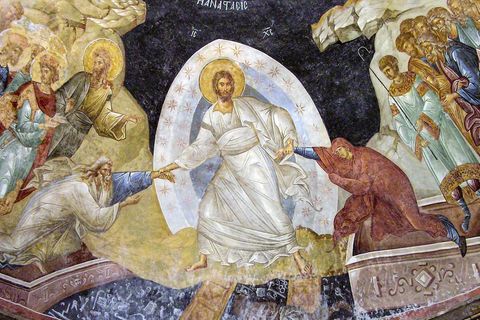
This Sunday, which according to the liturgical cycle of Eastern Pascha is called the Sunday of the Adoration of the Cross, the Church of Christ sets before our eyes the Honorable and Life-Giving Cross of the Lord. We gaze upon our crucified Savior, who accomplished the work of the salvation of humankind on the Cross.
The Cross of the Lord is the moment of the greatest humiliation and condescension, the condescension of a human being. But it is also the moment of God’s fullest revelation. Sometimes we think that in the midst of our tragedies and sufferings, God disappears somewhere, that He is not there. But precisely where we most think He is absent, there He is most present.
In the sufferings of our Savior, we recognize today the sufferings of the Ukrainian people. Through His crucifixion, the Son of God has entered into every human suffering of men and women of all times.
Today, as we venerate the Holy Cross of the Lord, we feel that Christ’s suffering is also the voice of Ukraine’s suffering. We feel that the Savior, our Lord Jesus Christ, is alive and personally present in the torn bodies of our defenders, our civilian men and women, who are being tortured in Russian prisons. Today, the Son of God suffers in the body of Ukraine.
Therefore, today, as we venerate the Holy Cross, we sing: “We venerate Your Cross, O Lord, and we glorify Your holy Resurrection.”
Lord, bless Ukraine! Bless our long-suffering people! Hear the prayers, pleas, and lamentations of our people for peace and an end to this war! Our crucified Savior, who reconciled humanity with God through Christ, bring Your true, heavenly peace to our Ukrainian land! Bless us with Your peace!
The blessing of the Lord be upon you, through His grace and love for mankind, always, now and forever, and for the ages of ages. Amen.
Glory to Jesus Christ!