“Spiritual Resilience and Christian Perfection: Being a Christian in Time of War”
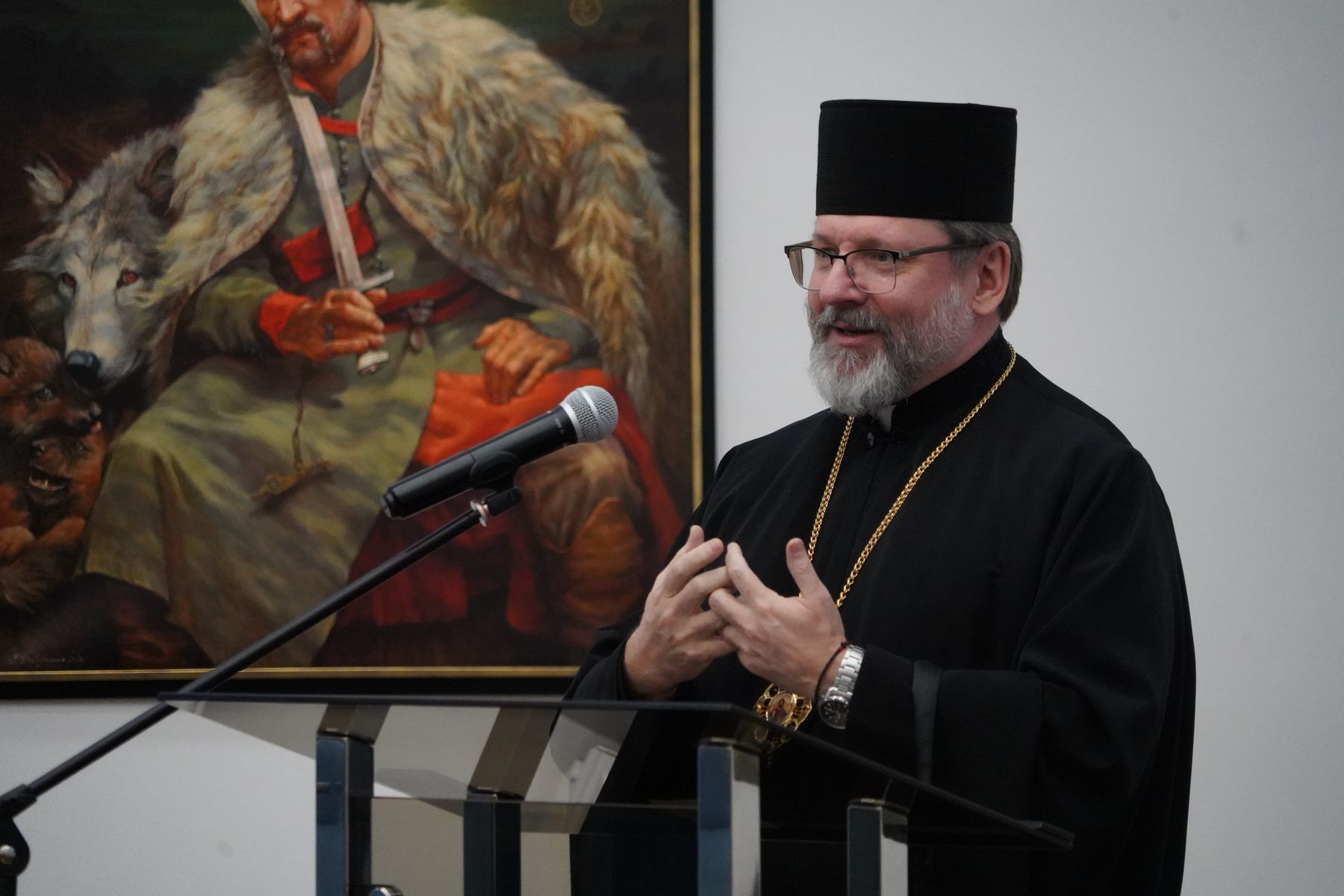
Address of His Beatitude Sviatoslav at the National Defense University of Ukraine, January 23, 2026.
Christ is born! Здоровʼя бажаю!
Distinguished generals, officers,Ladies and gentlemen,
Cadets and participants of today’s meeting!
It is a great honor and a special privilege for me to be here with you. I thank you for giving me a moment of your precious time in this unique institution—our National Defense University of Ukraine.
Today we had a truly unique meeting and signed a Memorandum of Cooperation between our Church, our educational institutions, and your University. This cooperation is not limited merely to providing military training for our seminarians and students of the Ukrainian Catholic University. It is about much more—about the future, about strategy, and about cooperation, including how we can work together today for Ukraine’s victory in this brutal war.
Spontaneously, in our conversation, by attentively listening to one another, we came to an important realization: if this war is properly reflected upon and deeply studied, the experience of this tragedy itself may become our invaluable capital—a national resource that Ukraine will be able to offer not only to Europe, but to the entire world. Indeed, this combat experience, this experience of resilience that we are gaining together today and that will be analyzed at a profound academic level, is capable of becoming a driving force in contemporary global thinking about war, peace, and victory.
Where else, if not here—at your University, which has numerous research institutes and is engaged not only in didactics, that is, teaching and learning, but also in serious scholarly work—should this extraordinarily important task of academic reflection on the experience of war take place?
I was very pleased to hear that your University is actively working on issues of communication—not only on how we speak today about the Armed Forces of Ukraine within our own society. I am convinced that our common task is to increase the prestige of the Ukrainian servicemember, so that today every Ukrainian would want to serve in the military, or at least have personal experience in defending the Homeland.
At the same time, it is critically important for us to learn how to formulate the right “message”—we may use this English word. How do we articulate our message to the world? We often feel that the world does not understand us, and when it finally begins to understand, it is sometimes already too late. When we spoke about how Europe sees Ukraine today—especially in light of recent events, when Europeans realize that adequate military assistance and protection from the United States may not be forthcoming—it is becoming increasingly clear that today the only truly combat-ready, modern, and experienced army in Europe is the Ukrainian army. Europeans now understand that investing in the Ukrainian army means investing in the future and in security. We truly are leaders and standard-bearers in this extraordinarily delicate, complex, sometimes tragic, yet profoundly noble cause—the defense of our Homeland.
Today, however, I would like to reflect together with you on the topic and concept of spiritual resilience. At present, the institution of military chaplaincy is actively developing within our Armed Forces. In accordance with the Law of Ukraine “On the Military Chaplaincy Service” of November 30, 2021, No. 1915-IX, we seek—on behalf of our Church—to provide the Defense Forces of Ukraine with the best priests. We have agreed that your University will prepare them as professional officers; however, their mission will be a special one.
What is the mission of military chaplains, and what does the formation of spiritual resilience mean? According to the new guiding document of the Armed Forces of Ukraine—the Doctrine “On Meeting the Spiritual and Religious Needs of Personnel”—the purpose of a military chaplain’s service is ‘the formation and maintenance of a sufficient level of personal spiritual resilience among servicemembers of the Armed Forces of Ukraine, necessary for the successful fulfillment of assigned missions.’ This task is carried out through meeting the spiritual and religious needs of personnel and their family members.
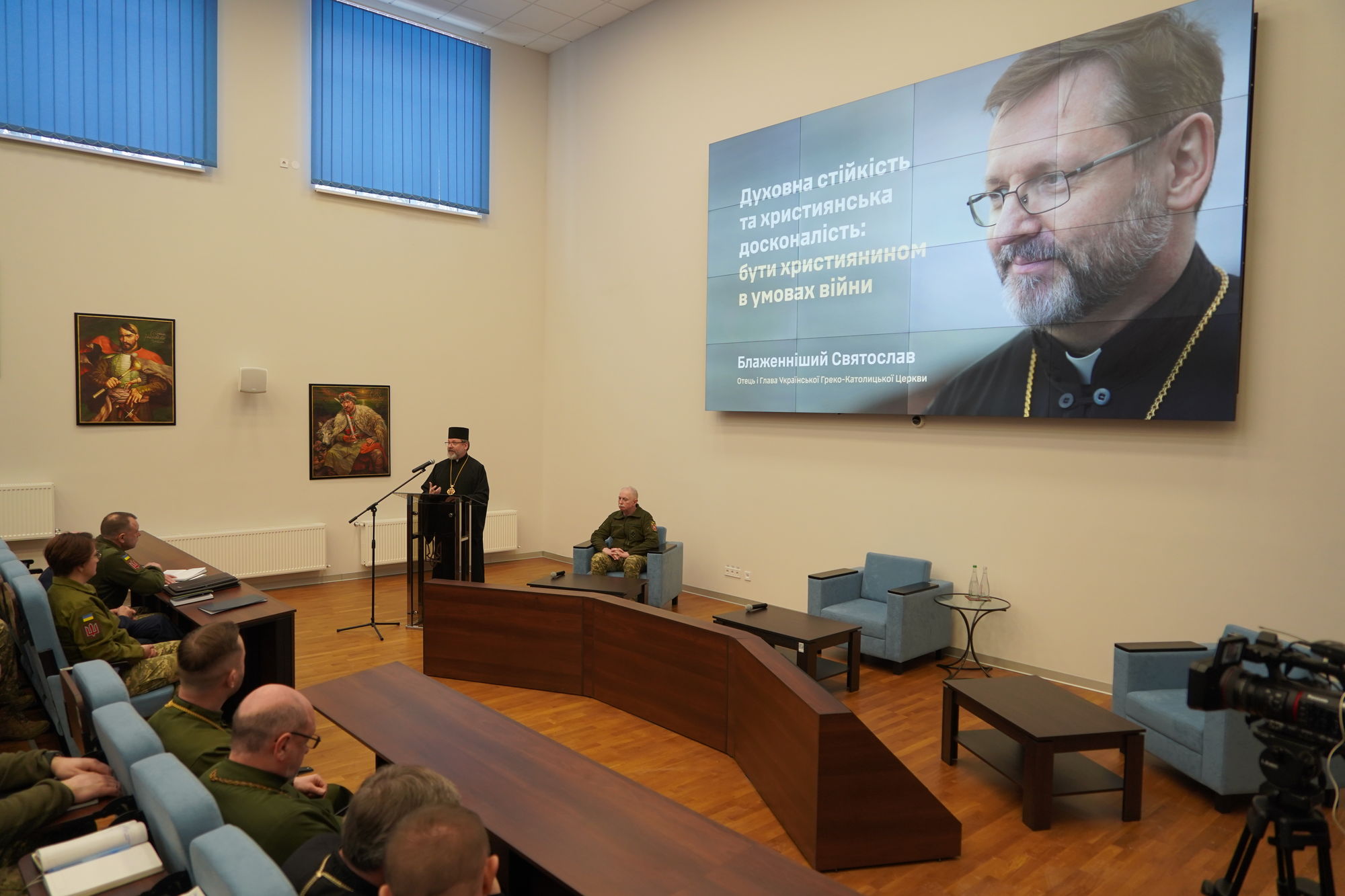
But what is personal spiritual resilience? What is its essence, and how is it formed, manifested, and sustained? Allow me to share a few reflections on spiritual resilience in light of the millennia-old Christian experience of perfection—or, more precisely, the striving for the perfection of the human person and of the Christian. I do not claim to provide an exhaustive answer to the question of what spiritual resilience is in all its types, forms, and parameters. This will also be the subject of your research. Using a methodological approach sometimes employed in mathematics, known as “proof by contradiction,” we may more easily understand what is at stake.
I believe it will not be a revelation to you that contemporary high-tech culture carries a major anthropological danger. It is sometimes described by the term “dehumanization,” that is, the loss of one’s humanity. In our daily lives, we increasingly communicate with various forms of technology, while the context and content of healthy, full human relationships grow ever poorer. This may also pose a challenge for pastoral ministry: very often a young person may be online with the entire world, connected to many people, yet feel profoundly lonely. Loneliness is an extremely painful scourge of modern humanity.
But dehumanization as a consequence of war is another challenge—an extraordinarily dangerous and horrific one—that is unfolding before your very eyes. I am encouraged to hear that the term “personnel” is often used. Yet there is a great danger that even a commander may begin to treat personnel merely as a human resource. Moreover, we are now facing an enemy that aggressively dehumanizes its own servicemembers. This constitutes one form of a crime against humanity, particularly in the context of this war. Not to mention the loss of dignity or respect for the dignity of the servicemember, and the proper honoring of the fallen—those heroes who gave their lives for the Homeland.
Our enemy, unfortunately, respects neither its own nor others and sometimes demonstrates to its servicemembers, even through its so-called “military priests,” that Ukrainians are not human. It dehumanizes the image of the enemy, and then all moral principles governing interpersonal human relationships collapse. Yet throughout the history of military valor, success in victory has always been based on the opposite.
The tradition of military art has never been founded on dehumanization; on the contrary, it has been founded on military virtues. Even the genealogy of military decorations derives from the concept of militari virtute. This classical understanding of military honor and valor comes from Roman military and administrative language and appears in inscriptions on orders, medals, diplomas, epitaphs, and coats of arms. Let us examine the concept of virtue as ex viro virtus. This ancient Roman notion derives from the Latin word vir, meaning “man,” from which the term “courage” also originates. This aphorism is often attributed to the Roman historian and statesman Sallust (86–35 BC), though he merely articulated widely accepted principles of the art of victory. Importantly, vir here does not mean simply a male person, but a human being—man or woman—as a citizen, a warrior, a person of character. That is why our contemporary understanding of resilience is grounded in the doctrine of virtues as the source of military and civic valor. “Resilience is a virtue,” says Greitens.
In Christian understanding, virtue is the perfection of a particular dimension of the human person, acquired through the training of intellect and will in good actions and transformed by the power and grace of the Holy Spirit. Therefore, when we speak of psychological, moral, and spiritual resilience, we mean the perfection of the body, the will, the intellect, and the spirit. True personal resilience cannot exist without reference to human perfection.
Even in wartime, the content of military education and chaplaincy from ancient times has been to help the servicemember remain human even in inhuman circumstances. This is a fundamental treasure of classical European Christian culture and civilization, which today must form the basis of our understanding of service and care for military personnel. We are called to care for the human person—for men and women who must be capable, in the fullness of their being, of defending the Homeland.
Here I would like to recall the core elements of Christian anthropology. From a Christian perspective, the human person is a unity of body, soul, and spirit. We do not have a body—we are a body. We do not have a soul—we are a soul. But we are also spirit. The integrity, unity, and flourishing of spirit, soul, and body in their proper virtues have always been the foundation of the Christian understanding of perfection. To be a Christian means to grow in the dignity of the human person, to reveal the image of God within oneself, to manifest likeness to God through the acquisition of the virtues of wisdom and courage, justice and temperance, crowned by faith, hope, and love. This is what we call the development of human virtues and Christian righteousness.
While philosophical and theological anthropology avoids Greek philosophical dualism or trichotomy—where spirit, soul, and body are seen as separate substances that overlap and sometimes conflict—modern personalism, both philosophical and theological, speaks of the three-dimensionality of the human person. A human being is at the center of an entire network of fundamental relationships and is revealed and realized through them.
Our corporeality is the dimension of human existence in the material, visible world, for we are part of this world. Our soul is the existence of the person in relation to the world and to oneself; it is the force that animates the body and drives the development of our unique personality. Yet there is also a spiritual dimension of human existence—a vertical sphere of relationship, the constant striving for self-transcendence and for going beyond the limits of one’s own nature. In Christian understanding, this refers to the fundamental orientation of the human person as the image of God toward its Archetype—toward the tri-personal God in whom we believe, who is communion within the Trinity, who can be encountered and who is supreme Love and Truth. This is why we affirm that every human being, as a religious being, exists in a dimension of searching for higher, spiritual values.
The three-dimensionality of the human person represents three directions of relationships within which personality develops. The spiritual dimension, however, is integral. Only when a person is oriented toward higher ideals do spirit, soul, and body—and all other relationships—become properly integrated. This classical idea of integration is powerfully summarized by Gregory the Theologian, Bishop of Nazianzus (a fourth-century Cappadocian Father). He states that one cannot understand the structure of a bird’s body without seeing it in flight; likewise, “a human being cannot be understood without God, for it is in God that one has one’s origin, meaning, and measure” (Oration 28).
It is interesting to see how this Christian vision is implemented in practice today. You may be familiar with the American veteran who began reflecting on the traumatic experience of war—Eric Greitens. His book Resilience: Hard-Won Wisdom for Living a Better Life was recently published in Ukrainian (Ranok Publishing, 2021). In Christian understanding, wisdom is a gift of God. My grandfather once said that there are many learned people, but few who are wise.
Greitens sought to understand resilience through the experience of military trauma and pain. In his book, he does not so much analyze the nature of spiritual resilience as describe how it manifests itself. He speaks of resilience as the capacity to endure pain and learn from it. If a person, as a rational being, does not reflect on experience—even painful experience—then that person cannot be resilient. Moreover, Greitens emphasizes that for resilience to be formed, particular attention must be given to personal choice: “Resilience begins with the ability to choose.” Personal choice thus becomes an expression of inner freedom and strength.
I once served in the Soviet army and remember basic training, where we were taught that a soldier has no choice. I recall an incident when a platoon commander publicly humiliated a soldier: “Why did you do that?” The soldier replied, “I thought…,” and the commander interrupted, shouting, “A soldier must not think; a soldier must execute orders precisely and on time!” I consider this an example of Soviet-style dehumanization.
Choice—inner and correct—provides an experience of freedom and strength. This resonates with the Christian definition of freedom. Freedom is not merely the ability to choose. There is always a possibility of choice, even under various forms of determinism. But it is the right choice that forms freedom. This is the classical definition of freedom given by the Greek Fathers of the Church. When I make the right choice, I am free; when I make the wrong choice, evil enslaves me. This is our working hypothesis regarding the nature and mission of military chaplaincy.
In my view, the task of cooperation between the Church and the Armed Forces of Ukraine—the task of pastoral ministry—is to help servicemembers remain human in inhuman circumstances and always make the right choice. Then they will acquire an inner experience of personal resilience as the result of correct personal choice, and consequently the experience of freedom, strength, and the capacity to prevail.
Greitens also notes that we often must endure circumstances we did not choose and cannot change. We did not start this war, but we must win it. When you find yourself in circumstances you did not choose and cannot change, what must be done to achieve full inner—especially spiritual and psychological—resilience? He answers: one must change one’s attitude toward these circumstances. I cannot change the circumstances, but I can change my attitude toward them. How is this done? What constitutes a proper orientation of will and intellect? This is the art of spiritual, Christian perfection, which the military chaplain must teach.
These are a few reflections I wished to share with you. Perhaps they will provide fertile ground for developing various hypotheses. Our Military Chaplaincy Service still has much work to do in articulating a clear understanding of spiritual resilience. For spiritual resilience, as I understand it, is the result of meeting the spiritual and religious needs of servicemembers. When we clearly understand our goal and know the methods and means to achieve it, we learn to prevail—each in our own sphere, on our own battlefield.
Allow me, in conclusion, to express my profound respect for all of you. I sincerely wish that this intellectual communion—this exchange of experience and reflection on this war—will become our shared treasure and legacy for the future.
By my secular education, I am a paramedic. I know that in the past, a Ukrainian medical scientist who made a discovery often had to wait years, even decades, to publish in an international journal. Today, however, physicians from all over the world—including military doctors—come to Ukraine to learn. Nowhere else in the world is there such a field of experience in treatment, especially in military trauma care. I am convinced that you will become leaders of global thought in the modern art of victory, in the art of waging a just war—a war whose purpose is to create space for peace. Wherever the Ukrainian soldier stands, there is space for peace and freedom. I often say that our servicemembers are today the foremost and best peacekeepers.
I am a witness to this, having lived through these difficult weeks, months, and years here in Kyiv together with your faculty and colleagues during the full-scale invasion—from the very beginning, from the siege of Kyiv, to the future victory. May the Lord God help us all.
Glory to Ukraine! Christ is born!
† SVIATOSLAV