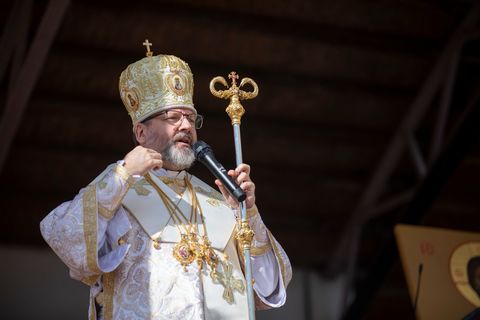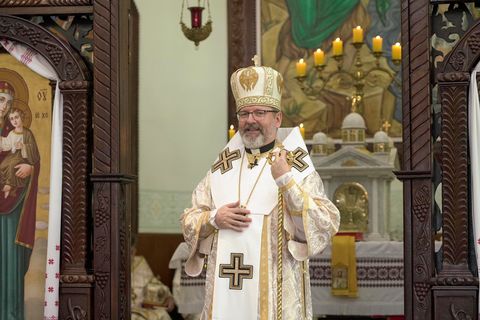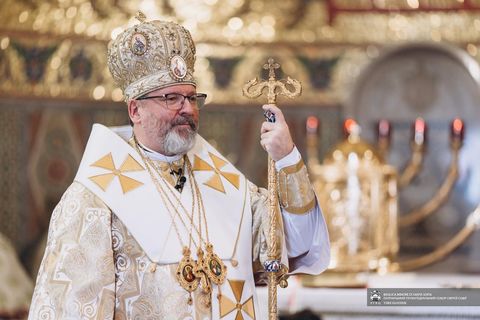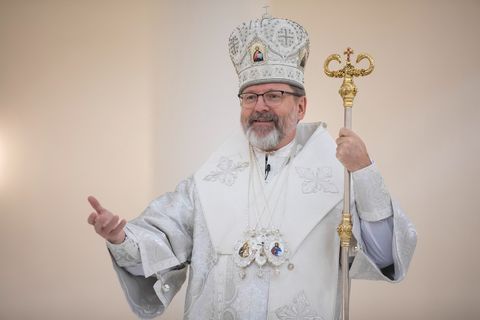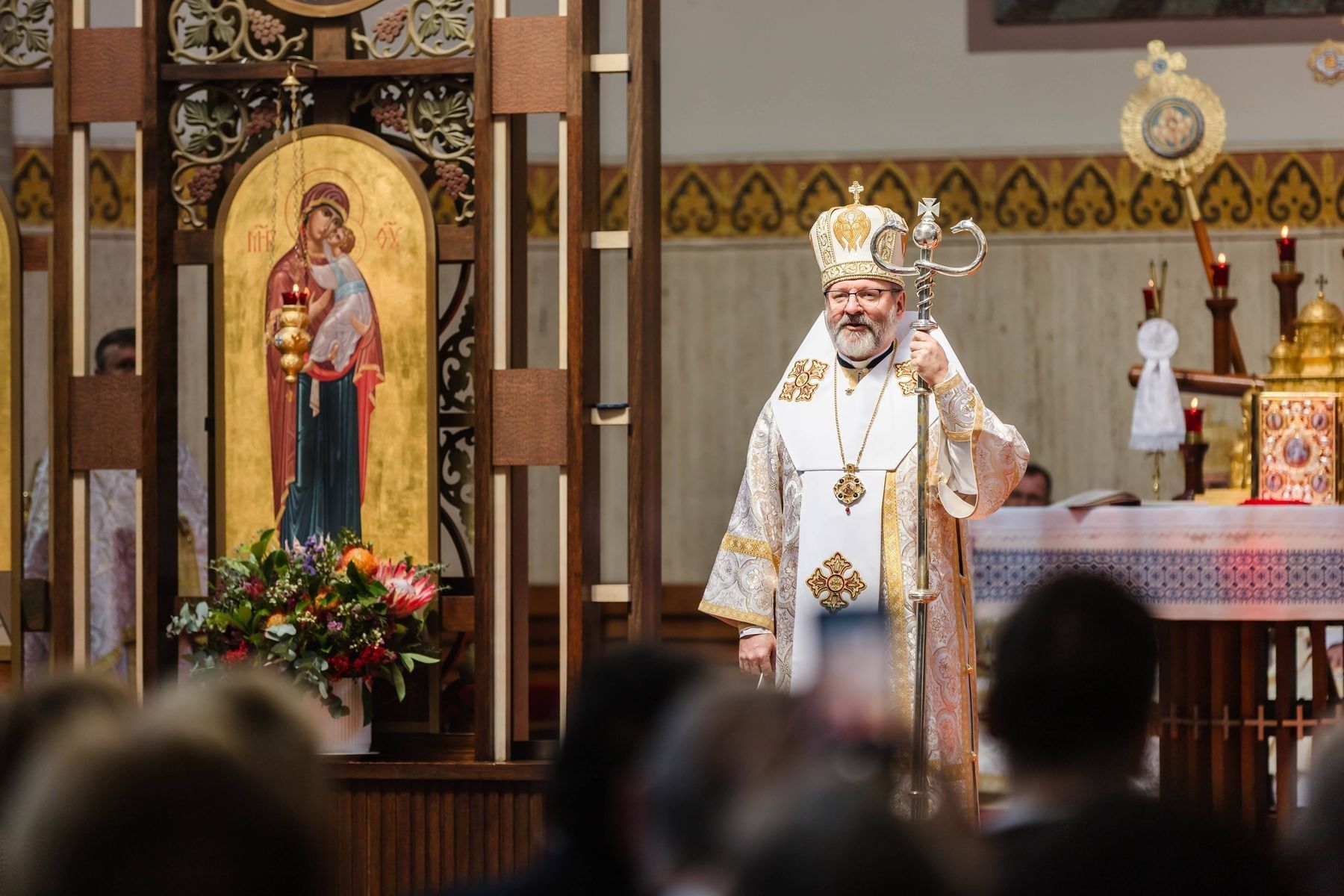
Homily of His Beatitude Sviatoslav on the 26th Sunday after Pentecost in Melbourne
“The land of a certain rich man produced a good harvest” (Lk 12:16).
Your Grace Metropolitan Borys!
Your Grace Archbishop Peter!
Your Grace Bishop Mykola!
Your Graces, beloved Bishops of the Permanent Synod of our Church!
Reverend and Very Reverend Fathers!
Reverend Sisters!
Distinguished representatives of the Ukrainian community in Australia!
Representatives of community institutions and organisations, our Plast and SUM youth!
Dear brothers and sisters in Christ!
Glory to Jesus Christ!
The fact that I stand here among you alive today is a miracle. Yet it seems the Lord God has sent us to you so that we may be a sign of hope, proclaimers of the faith of Christ’s Church in the Resurrection. We are, in this moment, witnesses of hope — those who announce the Good News of the Resurrection of our Lord Jesus Christ, which we celebrate this Sunday.
Today I want to bring you heartfelt greetings from Ukraine, from our golden-domed Kyiv, and to embrace you with the embrace of our Mother Church, so that you may know and be assured: although you live far away geographically, in Australia, you are not distant or estranged from Her.
I have not come to you alone today, but together with an entire gathering of our bishops. For the first time in the history of our Church, the Permanent Synod is holding its sessions here in Australia. This Synod is an icon of our global Ukrainian Catholic Church. We do not live only within a local reality. With us is the Metropolitan of Philadelphia, bringing greetings from our brothers and sisters in the United States. Here also is a bishop from Poland, from Wrocław, greeting you on behalf of the native Ukrainians of that region of Europe. There is the Apostolic Exarch for Ukrainians in Germany and the Scandinavian countries. And we come from Ukraine. We have arrived not only to bear witness to the unity of our great Ukrainian Church, but also to build that unity.
And today, on this day of unity and communion, the Lord speaks to us through the words of the Holy Gospel (Lk 12:16–21).
We hear the parable by which Jesus Christ responds to His listeners on an essential question: On what does my life depend? What is the foundation not only of being wealthy or successful, but of being truly alive as a human being? From where do we draw the strength to endure today’s challenges? What forms part of our national security? Christ tells of a rich man whose land produced a great harvest. This short parable speaks volumes, for not a single word in it is unnecessary.
First — we hear the word “land.” Interestingly, the Greek term χώρα used by the evangelist first means a small piece of land from which a person gains earthly happiness and wellbeing. But Christ immediately places this idea into a much broader context. For land is not only the plot on which one lives. In the Hebrew understanding, it signifies God’s blessing (cf. Gen 13:15). It is the Promised Land, the space of the Lord’s presence, human dignity, inheritance (cf. Gen 15:18), and roots — as the Ukrainian saying puts it: “the land where your umbilical cord is buried.” It is the place where a person can be dignified and free (cf. Ez 37:21–22).
If someone understands “land” narrowly — as an economic resource for personal enrichment — they become foolish and reason like the rich man in the parable: “My land has yielded well… I have nowhere to store my crops! I will tear down my barns and build bigger ones…” (Lk 12:16–18).
Yet this man, in saying he will gather all his goods into these new barns, in fact reveals his poverty: “…and I will store there all my grain and my goods.” (Lk 12:18).
He is truly poor if all his wealth amounts only to what can fit into barns — even large and newly built ones! There are many kinds of poverty: besides material poverty, there is spiritual, moral, cultural, and intellectual poverty. A person may have much money, but if they possess nothing greater than what can be stored in a shed, they are a poor and unhappy person. The man in the parable did not understand that he needed not to expand his barns, but to enlarge his heart — for God and for neighbour. Only then can one become “rich toward God,” and only what is stored in these “heavenly barns” through acts of love will last for eternity.
Second — the greatest poverty of this man lies in the fact that he fails to recognise that the most precious wealth he has — the fruitfulness of his land — comes from God, who gave the harvest from that holy soil! If he does not realise that there is something more important than material bread, he is truly poor — the kind of person my predecessor, Patriarch Lubomyr, called a “nouveau riche”: someone with money but without culture. So the man says: “My soul, you have ample goods laid up for many years; relax, eat, drink, be merry!” (Lk 12:19).
He does not understand that the soul does not live on earthly bread. Only the heavenly bread, which we receive in the Eucharist, nourishes the soul and grants joy today and tomorrow, and peace forever.
Third — the Word of God places before each of us today the question: “… And the things you have prepared — whose will they be?” (Lk 12:20).
A wise person, who works, must think about the future. People in the diaspora ask themselves the same question: all that we have built — our homes, our churches, our organisations — to whom will it belong?
The answer is profound: the future belongs to God alone. If you have preserved in your heart an understanding of your roots, if you have preserved the faith — everything you have built will remain after the Lord calls you to His dwelling. If not — descendants without faith will quickly squander everything, and all that you have achieved: whose will it be?
Today you hear from various media voices talking about land in relation to Ukraine. They say to us: Give up territory, and you will have peace. But our message to the world is this: the Russian aggressor is not waging war over territory. Russia is one of the largest countries in the world. It has land and resources, yet the demon of war and the slavery of sin leave neither its rulers nor its people able to live in peace or enjoy the fruits of their own land. The aggressor’s aim is the destruction of the Ukrainian people and the reshaping of how democratic societies think — to corrupt them from within and enslave them. One cannot make peace with a criminal by feeding his appetite. He must — and can — be stopped!
For people for whom Ukraine is a place of dignity, heritage, and freedom, it is worth far more than land or minerals. It is the holy place where God dwells with His people. And this cathedral in Melbourne is a message and an enduring testament of the first Ukrainian settlers in Australia. Your forebears, who arrived as refugees deprived of home, brought with them the treasure of faith, language, culture, dignity, and freedom. They preserved the words “O Lord, great and almighty, protect our Ukraine,” inscribed in this church when an independent Ukraine no longer existed after the horrors of the Second World War. Your predecessors prayed and struggled for a free Ukraine — the Ukraine we now have, build, and defend on our native soil, paying the highest price: the lives and health of our finest sons and daughters.
Today we thank God that He preserves us in life, so that we may be a voice to the world about the true meaning of human life. Our task is to preserve the greatest treasure borne of Ukrainian soil — the faith of our ancestors. Do not lose it, for in it lies your wealth. Without it your children will lose everything. And all that you have built — whose will it be?
Our Church has a great mission: as the witness of the Lord’s closeness in Ukraine today, to share the faith with all nations, to share the experience of the suffering Christ present in the body of our people even in the midst of this terrible war. Our vocation is to be a Church that does not merely maintain old structures or institutions, but is missionary, alive in the Holy Spirit — youthful, resilient, life-giving — proclaiming the Gospel of Christ to the nations across continents.
I sincerely thank you here in Australia for supporting your brothers and sisters in Ukraine. Thank you for understanding that all that the Australian land gives must be shared with those in need. Thank you for your solidarity. When the enemy tries to take everything from us — when he destroys our cities’ infrastructure, seeking to freeze us in winter and leave us in darkness — then the light of the human heart shines brightest. We carry light within us. When the enemy takes warmth away, we warm one another with the warmth of our hearts.
Thank you for enlightening and warming millions of Ukrainians with your hearts. Together with the bishops of the Permanent Synod, we wish to stand here as witnesses of hope. Ukraine today is a space of global change. These changes will reach Australia as well. So please — be on the right side of history. Be assured: Ukraine stands, Ukraine fights, Ukraine prays. Amen.
Glory to Jesus Christ!