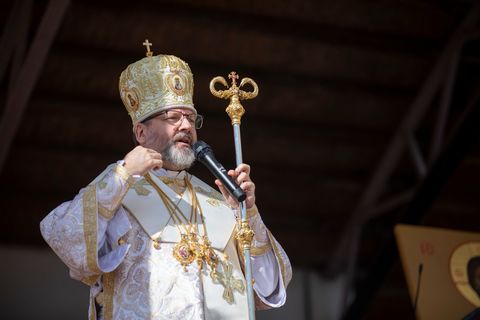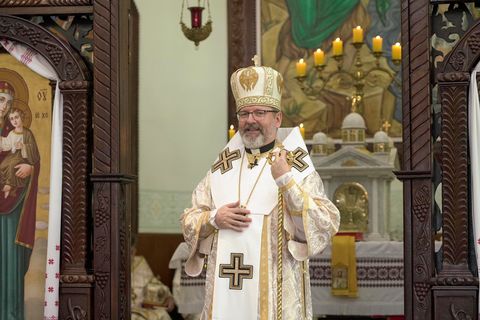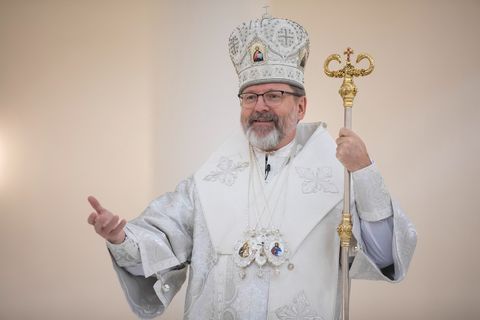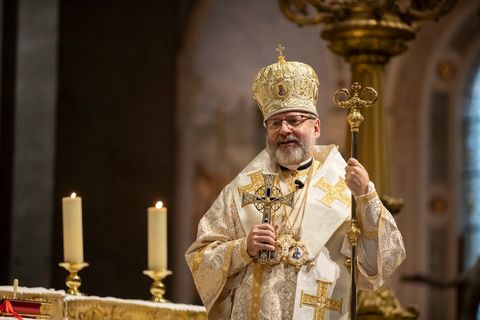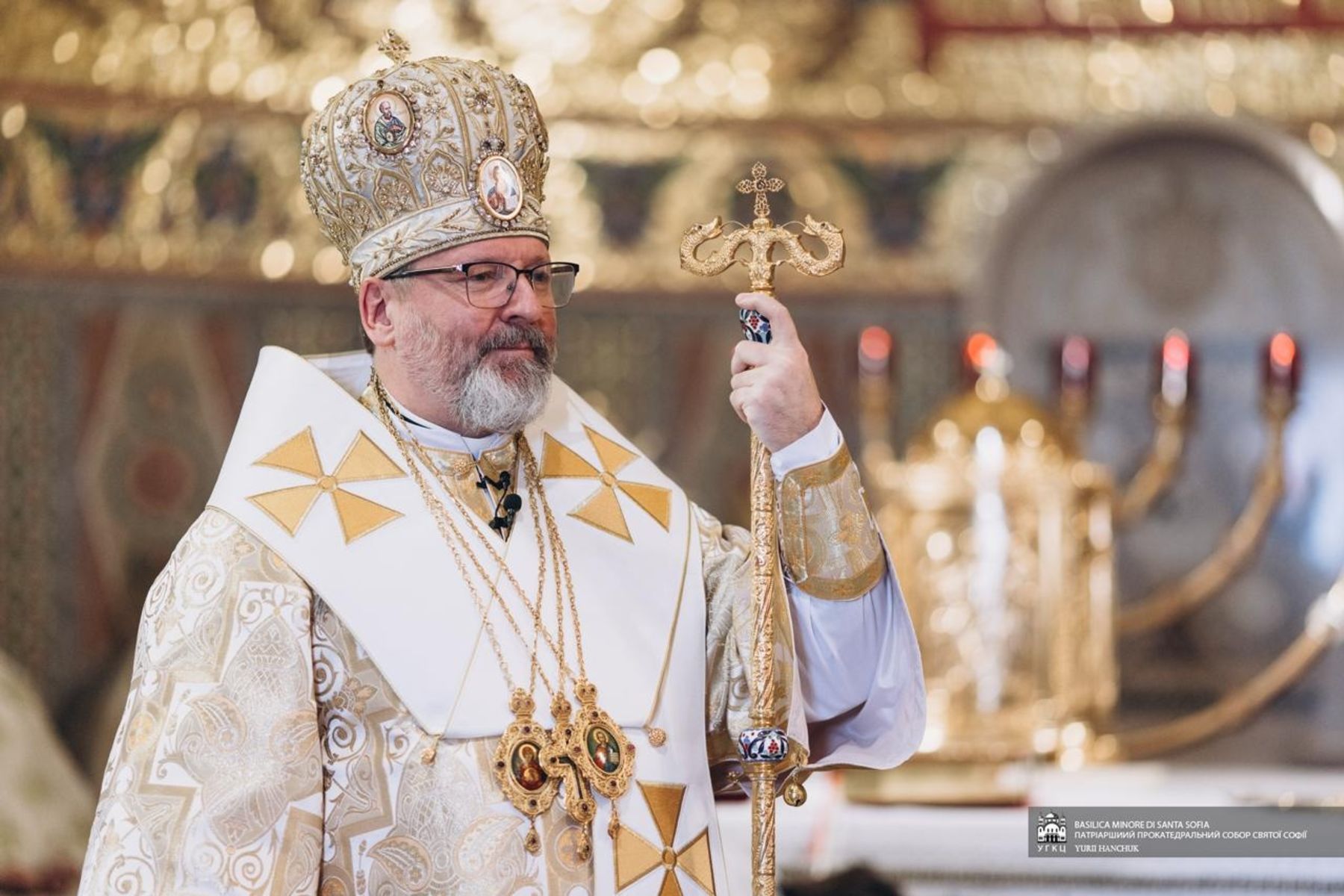
Homily of His Beatitude Sviatoslav on Meatfare Sunday in Rome
“Truly, I say to you, as you did it not to one of the least of these, you did it not to Me.” (Matthew 25:45)
Your Eminence, Cardinal Prefect,
Your Excellencies, Most Reverend and Right Reverend Hierarchs,
Reverend and Venerable Fathers present here,
Dear members of our Ukrainian Roman community,
Dear members of the Galadza family, who have gathered today almost in full in this historic church,
Dear pilgrims from various countries of the world who have joined us for this celebration,
Dear brothers and sisters in Christ,
Glory to Jesus Christ!
According to the liturgical rhythm of the Gregorian Paschal cycle, the Church today leads us to the Sunday known as Meatfare Sunday. It directly prepares us for the Great Forty Days—a privileged time of repentance, of the human person drawing closer to God and of God drawing closer to the human person. This period we call the Great Fast.
The Gospel proclaimed today speaks to us about the fulfilment of human history. This passage of Sacred Scripture reveals the ultimate purpose and final meaning not only of Christian life, but of the life of all humanity—of every human person, man and woman alike. This Gospel text is not a parable but a prophecy, for it speaks of a reality that will inevitably touch each one of us. The attentive listener is particularly struck by the solemn tone and prophetic authority with which these words are spoken by Christ Himself.The Lord reveals His glory to us. As the Evangelist proclaims: “When the Son of Man comes in His glory, and all the angels with Him, then He will sit on the throne of His glory” (Mt 25:31). Christ speaks first of all about the full and visible manifestation of the Kingdom of Heaven and the universal reign of our Lord. At the same time, it is important to note that the image of the final and fearful judgment is not static nor postponed to some distant future. On the contrary, it is dynamic in nature and draws closer to us each day and each night. The Lord is coming even now, and through this prophetic word we are called to discern His presence in our midst.
It is significant that, in revealing the definitive criteria by which each person will be judged—either condemned or justified—the Lord speaks of a particular kind of service. A person receives eternal reward or eternal condemnation not because of knowledge or abilities, nor because of social status—whether rich or poor, powerful or weak. The decisive measure revealed by Christ today, and accessible to all, is the service of love toward the least and most vulnerable of our brothers and sisters. “Truly, I say you,” He says, “as you did it to one of the least of these my brethren, you did it to me” (Mt 25:40).
In other words, Jesus Christ already today identifies Himself not with the powerful of this world, but with the least. What each of us has done for the least will become our passage to heavenly glory.
It is striking that the Kingdom of Heaven is already open and near—indeed, it draws closer to us each day. We ourselves choose our eternity and determine where we will stand: among those who reject God’s love or among the heirs of the blessedness of His Kingdom. Each of our actions shapes and forms us, marking us with those signs we will bear before the public and final judgment. These marks, formed by our deeds, will be clearly visible, as the signs by which a shepherd distinguishes sheep from goats. In the same way, each person will be recognized and placed in his or her proper place on the last day of human history. No one will escape this reality—it will touch each one of us.
Dear brothers and sisters in Christ, today I come to you from a freezing yet unbroken Kyiv as a witness to the resilience and steadfastness of our people. Imagine the harshest winter of the past decade in the capital of Ukraine. Entire residential complexes and massive apartment buildings, each home to more than three thousand families—comparable to entire villages in Western Ukraine—are freezing, without water, without electricity, without sanitation, without even the most basic means of survival.
Yet I see the face of our people. Just last Sunday, a five-year-old boy shared with me his experience of living in Kyiv. I asked him, “Is it cold in your home?” He answered: “If I overcome the cold, Ukraine will win.” These words were spoken by a child who is five years old!
There is another image that has appeared in the headlines of public television in many European countries. In one of Kyiv’s districts—Troieshchyna, which suffered most from this freezing tragedy—so-called “Points of Resilience” have been established. People from frozen buildings gather there to warm themselves, drink hot tea, charge their devices, and simply be together.
What is remarkable is that during the past several days, people in these centres have not been weeping, but singing and dancing to music. This image—of people who are freezing yet singing and dancing—has already entered the history of Ukraine’s resilience. Polish journalists, commenting on it, asked: “Is this even possible?” Yet today, in Kyiv, this is reality.
I can testify that this extraordinary resilience and even joy, shown by people who face death each night, does not come from human strength alone. It is a gift of the Holy Spirit. Anyone with even basic Christian sensitivity understands that these people, this nation, are the least brothers and sisters of Christ, with whom He personally identifies Himself in today’s Gospel. We recognize with gratitude that today the “least” have become visible to the world, for they are the least brothers and sisters of Jesus Himself.
In response to these testimonies, images, and reports from Kyiv, a renewed wave of solidarity has arisen—one not seen for many years. In previous years, assistance to Ukraine had been diminishing, as fatigue and weariness had taken their toll. Today, however, a wave of authentic Christian solidarity and love is rising. This very Sunday, collections are being taken in parishes—not only Ukrainian ones—throughout Italy and other European countries to assist the most affected and vulnerable people, not only in Kyiv but throughout Ukraine.
I am here to bear witness that this Christian mercy is not mere human philanthropy. This service is an authentic Christian liturgy. We express our sincere gratitude to Pope Leo XIV, who discerned in this solidarity the spirit of Christian love that calls the Church back to service where Christ is present today. If the liturgy is the solemn, communal, and public worship of God—our service to Christ present among His people—then this Church-wide movement of mercy toward the most vulnerable brothers and sisters of Christ in Ukraine possesses a deeply religious character and is itself a genuine liturgical act of the Church. We thank all those who have recognized where our Lord Jesus Christ is present today and have offered Him a true and authentic liturgy.
Dear brothers and sisters in Christ, today we also experience a particular moment of joy and celebration. Our Lord grants our Church a new priest. This is a special joy not only for the Ukrainian Greek Catholic Church, but for the entire Church of Christ.
Deacon Daniel—and in a few moments, Father Daniel—reveals through his personal vocation the true face and identity of our Church. It is a Church poor in material resources yet rich in its people; persecuted yet risen; a minority in Ukraine yet significant for the majority of the nation’s citizens; not merely local, but truly particular and universal, with its own identity, history, and tradition—theological, spiritual, canonical, and liturgical. Today Kyiv and Toronto rejoice; Ukraine and Canada rejoice together.
I will share a small secret with you. Daniel came to our home, to me, to Kyiv, on the Sunday of the Prodigal Son. And today, in Ukraine, according to the Julian Paschal cycle, we also celebrate the Sunday of the Prodigal Son. It was a special joy for me that the Lord entrusted to me the task of taking him by the hand—first leading him to the diaconate, and now to the priesthood. Daniel lived for years in our home, and even now his room remains in our residence, untouched, with his beautiful icons. We prayed together and lived daily the dynamic of service to the Church. Today I am happy to come from your Mother Church in Kyiv here to Rome to introduce you into the eternal priesthood of Christ.
We had already made one attempt to ordain him, but it did not succeed. The words of the Servant of God Lubomyr come to mind: “The Lord speaks through circumstances.” God prepared a particular word for Daniel, which we have heard today and which will become the motto of his priestly ministry: “What you did for my least brothers, you did for me.” Perhaps this is the very meaning of liturgy in the contemporary history of humanity.
Some may ask whether it is possible to unite the vocation of a professor teaching at prestigious chairs of liturgical theology in the Catholic Church and serving the Holy Father in the Dicastery for the Eastern Churches with service to the least of the brothers and sisters of Christ. Must academic and intellectual work be diminished for the sake of social service? Do these two forms of service truly exclude one another?
Saint Augustine helps us resolve this theological question. In his prophetic text On the Teacher (De Magistro, 14, 45–46), he observes that the service of the teacher is a service of love and mercy. The teacher removes ignorance from the heart and mind of the student and leads the student to the knowledge of truth. Ignorance of God causes us to lose everything we have and leaves us weak and lost in eternity. A true teacher, a disciple of Christ, enlightens students—this is an act of mercy. The professor does not humiliate the student or exploit ignorance, but strengthens the student by teaching the truth and leading him or her toward its fullness.
This is why our great predecessors, Metropolitan Andrey and Patriarch Josyf, in defending the dignity and rights of their people, cared deeply for education, scholarship, and formation. They sought to provide their children with opportunities to study at the finest universities and schools in Europe and throughout the world, and they dreamed of establishing their own Ukrainian Catholic University. This Cathedral of Saint Sophia—Holy Wisdom—in Rome stands as a witness to their love and sacrifice for their enslaved and wounded, yet wise and great people.
Perhaps it is by God’s mysterious design that your ministry, Father Daniel, will become a means of leading students—those least of the brothers and sisters of Christ—into the mystery of the liturgical theology of the Church of Christ. For this reason, we rejoice in you. We rejoice that the Lord God is with us—under missiles and bombs in Ukraine, and wherever our Church is present among her faithful throughout the world. God cares for His Church and sends her new priests.
Today we glorify the Lord and reorient our life priorities so that one day we may be ready to hear the blessed words: “’Come, O blessed of My Father, inherit the Kingdom prepared for you from the foundation of the world” (Mt 25:34). Amen.
Glory to Jesus Christ!
† SVIATOSLAV