Address by the Head of the UGCC for the 246th Week of the Full-Scale War, November 1, 2026
Glory to Jesus Christ!
Dear brothers and sisters in Christ! This Sunday, the first day of the new month, we mark the 246th week of this devastating, bloody, and horrific war. Intense fighting continues along the front lines. Every day, we receive reports that more than a thousand Russian soldiers are killed along the front lines.
Blood continues to be shed in our cities and villages. We thank the Lord God and the Armed Forces of Ukraine that, this week, too, we have been able to stand firm and endure, and that our struggle has borne fruit. Yet again, this has been a week of blood, pain, and tears in our peaceful cities and villages.
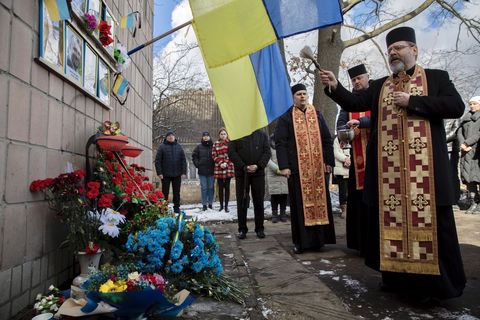
The whole world was appalled by the attack that took place on October 29 in our glorious city of Dnipro. The Russians deliberately struck the city’s railway station, killing 15 people. More than 15 others were wounded, including an 11-year-old boy.
It is worth noting that railway workers who were trying to rescue people were among those killed. The very next day, the enemy struck the same location at Dnipro railway station again. We extend our deepest condolences to the families and loved ones of the victims, and we surround all those who were wounded with our prayers and support.
The enemy continues its relentless attacks on our cities and villages, destroying their vital infrastructure. This week, the UN Independent Commission designated such systematic actions by the Russian state as war crimes and crimes against humanity. Such acts of terror have become part of the aggressor state’s policy.
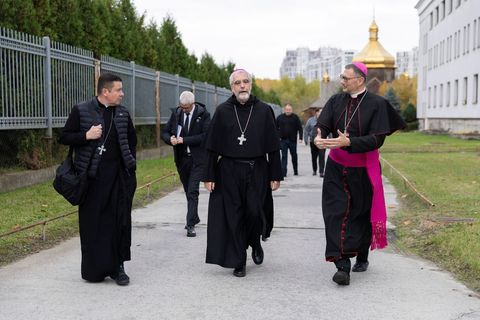
This week, we are especially grateful for the visit to Ukraine by the Papal Almoner, Archbishop Luis Marín de San Martín, who traveled to Zaporizhzhia, Poltava, and Kyiv. He was right at the epicenter of the bombings and strikes targeting our cities and villages. We are grateful that, through this initiative, Pope Leo wishes to embrace Ukraine with his humanitarian aid.
We are also grateful that Archbishop Luis met with the clergy of our Kharkiv Exarchate, which is in desperate need of support and assistance.
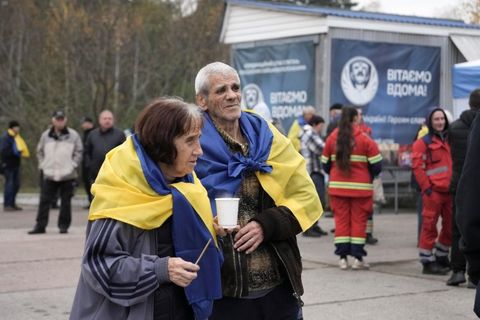
Today, we wish to remind everyone once again that Ukraine does not end at the front lines. This week, the campaign to rescue the residents of Oleshky has been particularly prominent.
We thank everyone who helped bring the hostilities to a halt and evacuate people from this long-suffering city, whose residents had been starving for many months.
However, we want to remind everyone that there are many places like Oleshky in the occupied territories. Today, we must remind ourselves that our Ukrainian brothers and sisters living beyond the front lines are just as Ukrainian as we are.
Today, we pray especially for our brothers and sisters in the occupied territories.
We welcome with open arms all those who can be rescued from Oleshky. We want to help in every way we can.
But the world must not forget the human rights violations taking place in the occupied territories: torture, imprisonment, and persecution, including the persecution of religious communities and congregations in these areas.
To all those who have turned their eyes, prayers, and hearts toward Ukraine this week, we express our heartfelt gratitude and once again declare to the whole world: Ukraine stands firm! Ukraine is fighting! Ukraine is praying!
This week, the regular assembly of the secretaries-general of the European Bishops’ Conferences took place in Salzburg, Austria—the renowned birthplace of Wolfgang Amadeus Mozart.
The heads of the Catholic bishops’ conferences of European countries gathered for their annual meeting, where they discussed pressing issues and challenges and elected a new president and two vice presidents. Of particular interest, however, was the opportunity to hear about the current state of the Catholic Church in Europe, which is facing new crises and challenges. The discussion was focused on the ministry of priests in today’s circumstances and the formation of our seminarians.
The bishops also focused on the participation of local Churches in the synodal journey of the universal Church, particularly at the continental level in Europe.
In conversations and meetings of this kind, our Church is called to bear special witness to synodality within the Church of the Eastern tradition. The bishops listened with great interest as we explained that synodality in our Ukrainian Greek Catholic Church has its own distinct structure and strength.
Today, we emphasize that our synodality brings together the laity, monastics, clergy, and bishops. The local Church, as the Body of Christ, does not limit synodality to the laity alone. We affirm that the local Church must experience the fullness of its synodal journey.
Thus, we are speaking not only of the baptized, but of those who live out their baptism through the sacraments of Confirmation and the Eucharist—both the laity and monastics. But there is another level of synodality in the local Church.
This is the participation of the presbyterate and the collegiality of bishops. Only when the entire body gathers at the synod of an eparchy or at the Patriarchal Synod of the entire Church can we consult one another and discuss matters of common concern. The synod is an advisory body, but it is founded on episcopal collegiality and also serves as a legislative body.
Thus, what begins as the advisory voice of the entire body of the Church becomes the law of our Church and is put into practice in our daily lives. It is very important for us to remember that, alongside Patriarchal Councils, we also have our own synods. Interestingly, next Saturday, the next session of the Patriarchal Forum will take place.
We cannot convene a Patriarchal Council under wartime conditions, but we do convene Patriarchal Forums, including online, in order to foster the global unity of our local Church. As we have said, for us, the local Church is not defined by geographical boundaries.
We are not merely a local Church in the geographical sense; ours is a local Church with a global dimension, uniting Ukrainians throughout the world in the bosom of our Mother Church, rooted in the Kyiv tradition.
Today, November 1, we commemorate the righteous Metropolitan Andrey Sheptytsky, the father of our Church’s unity in modern times. He was a Church leader who was the first to recognize his responsibility for his faithful not only within the territory of the Lviv Archeparchy, but also beyond it. He visited Canada, the United States, Brazil, and Argentina, thereby uniting the global Ukrainian community within the bosom of our Mother Church of the Kyiv tradition. Today, we especially remember Metropolitan Andrey Sheptytsky as Ukrainians from across Italy make a pilgrimage to the famous shrine in the city of Pompeii.
Together, we pray for our homeland and for our Ukrainian people, both in Ukraine and throughout the diaspora. We ask the Lord to grant peace to our homeland.
May the Mother of God, whose miraculous presence has been so greatly glorified in the city of Pompeii, intercede for us in heaven. Lord, stop the war and bless the long-suffering Ukrainian people with the gift of a just and heavenly peace.
The blessing of the Lord be upon you, through His grace and love for mankind, always, now and forever, and for the ages of ages. Amen.
Glory to Jesus Christ!