Address by the Head of the UGCC for the 244th Week of the Full-Scale War, October 18, 2026
Glory to Jesus Christ!
Dear brothers and sisters in Christ!
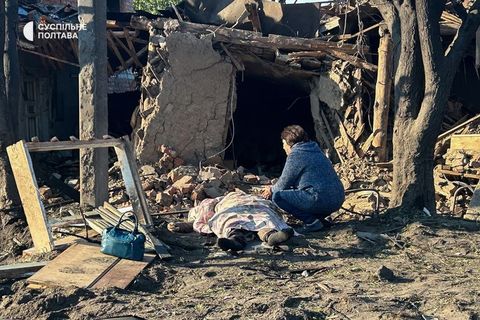
This Sunday marks the 244th week of this cruel and sacrilegious war. Ukrainian soil is once again groaning under the blows of Russian missiles and bombs. Once again, the blood of Ukraine’s civilians is being shed, day and night.
We thank the Lord God and the Armed Forces of Ukraine that we have endured another week and are still alive. It is our duty to bring the truth about Ukraine to the hearts and consciences of good people, of people of good will throughout the world.
This week, on the night of October 14, the enemy once again launched a massive, devastating attack on Ukraine. In Kyiv alone, 25 ballistic missiles were fired at the city. These missiles were designed to strike military ships at sea, yet they were used against civilians instead.
Critical infrastructure was the main target of Russian strikes on our peaceful cities and villages. According to the information available to us, for the past month the enemy has been attempting to cut off cities such as Kyiv, Odesa, and Kharkiv completely from supplies of heating, electricity, and water.
The aim is to turn these cities, home to millions of people, into ghost towns. In the attack on October 14 alone, 30 facilities in our power grid were destroyed or severely damaged. As a result, 600,000 people were left without electricity at once.
But what pains us most is that crimes against humanity of this kind were committed precisely when the U. S. president announced a so-called energy ceasefire between Russia and Ukraine. Neither the Russian nor the Ukrainian side confirmed that such a truce had been agreed upon. It is therefore very important for us, as Christians, to understand that even peace negotiations and efforts to end a war must be governed by moral principles. Agreements reached without regard for such principles, in which energy resources are valued more highly than human life, are doomed to fail.
Ukraine’s experience this week has confirmed this. That is why we must recognize the human dimension of international negotiations over energy supplies.
When we talk about energy, I ask all of you to remember that we are talking about real people—the children in kindergartens and schools, the patients in hospitals, and the families whose lives depend on these essential services.
Agreements must be assessed first and foremost by the extent to which they alleviate the suffering of the civilian population, not merely by the political or economic benefits they yield or the high-profile political statements they generate. And even as we gratefully acknowledge mediation efforts aimed at ending the war, it is essential to distinguish between restraining an unjust aggressor and coercing the victim.
It is also vital that our friends in the international community understand that Ukraine’s dependence on aid gives no one the moral right to dictate its future without the participation of the Ukrainian people themselves. We must not blur the distinction between the aggressor state and the people who have the right to defend themselves.
In international efforts to end any war—including Russia’s war against Ukraine—it is essential not to set peace against justice.
His Holiness Pope Leo teaches us this directly: there is no peace without justice, especially when it comes to innocent victims.
A ceasefire that saves lives is precisely what deserves our support and respect.
As Ukrainians, when we hear about negotiations, meetings, or discussions, we must not immediately interpret them as acts of betrayal. At the same time, agreements that lack moral principles cannot be called peace.
Another essential element in thwarting the aggressor and achieving a just peace is recognizing that Ukrainians have the moral right to participate in the decisions and negotiations that concern their future. Ukraine is a subject of international law and must not be reduced to a bargaining chip, especially when certain parties prioritize interests other than the protection of innocent victims in Ukraine.
Ukraine has agency of its own; it is not merely an object of other people’s interests.
Today, it is so important for us—the people of Ukraine, those who stand for truth, justice, and freedom—not to succumb to moral disillusionment. Worst of all, we must not allow disillusionment to turn into moral indifference.
The inconsistency of influential states does not diminish the value of the principles, freedom, and truth for which we are paying the ultimate price—our lives.
I want to address our international partners and urge them to recognize their moral responsibility before history for all that must be done today to put an end to Russia’s unjust aggression against Ukraine.
Today, I want to thank all those communities that defend human dignity in the modern world and affirm the value of every human life, regardless of religion, race, or political affiliation. It is vital that we not reduce the tragedy unfolding in Ukraine to the cost of resources or the convenience of a political compromise.
And today, we all want to say proudly: Ukraine stands! Ukraine fights! Ukraine prays!
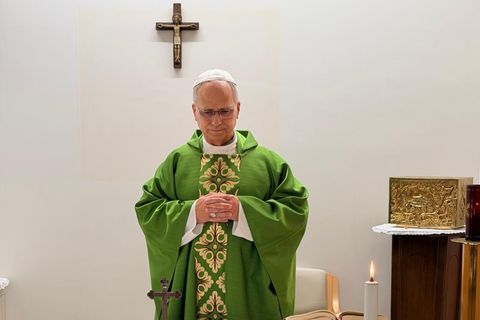
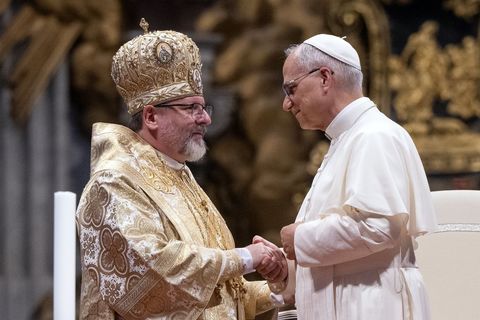
This week, while in Rome, we joined the heads of the Eastern Catholic Churches and the leaders of episcopal conferences of the Latin Church from various countries around the world in accompanying Pope Leo XIV on his road to recovery. We prayed for his health and for the success of his surgery.
We eagerly await his return to his active ministry and service for the good of Christ’s Church in our time. We also wish to thank him once again for the efforts he is making—even in such difficult times—to save the residents of Oleshky, who are suffering amid a humanitarian catastrophe.
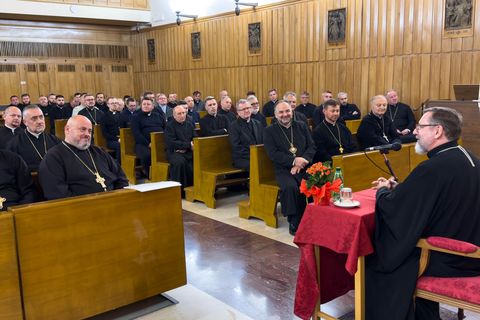
Today, however, I want to greet you from Latvia, from the city of Riga, where we are making a pastoral visit to the Ukrainian community in this country.
The history of our Church’s presence in the Livonian lands dates back to the 11th century. At that time, these communities belonged to the ancient Kyiv Metropolia. Since the Union of Brest, our Church’s presence in these regions has grown significantly and experienced a period of flourishing.
A new phase in the history of the Ukrainian presence in Latvia began after the collapse of the Soviet Union. As early as 1992, the Ukrainian Greek Catholic Parish of the Transfiguration of the Lord was established in Riga. Today, amid the full-scale Russian invasion, our community in Latvia is actively working to defend our homeland and provide humanitarian assistance.
I would especially like to thank the Archbishop of Riga, His Excellency Bishop Zbigniew Stankiewicz, for his particular care for Ukrainians in Latvia. Today, this relatively small country has taken in nearly 80,000 Ukrainian refugees fleeing the war. I want to thank our clergy, community leaders, and activists for being a strong voice for Ukraine, appealing to the consciences not only of the people of the Baltic states but of people throughout Europe.
I have come to Riga to embrace Ukrainians in this country with a father’s embrace and to assure them that the Mother Church, the Church of Kyiv—which is bleeding today—cares for her children throughout the world. I have also come to remind them of the motto of our Patriarchal Council: “Your Church is always and everywhere with you.”
God, bless Ukraine! God, bless the children of Ukraine, wherever they may be in the world today.
God, help the wise and thoughtful people of our time to put an end to the wars raging throughout the world today. God, stop the war in Ukraine and bless our people, our Church, and our nation with Your just and heavenly peace.
The blessing of the Lord be upon you, through His grace and love for mankind, always, now and forever, and for the ages of ages. Amen.