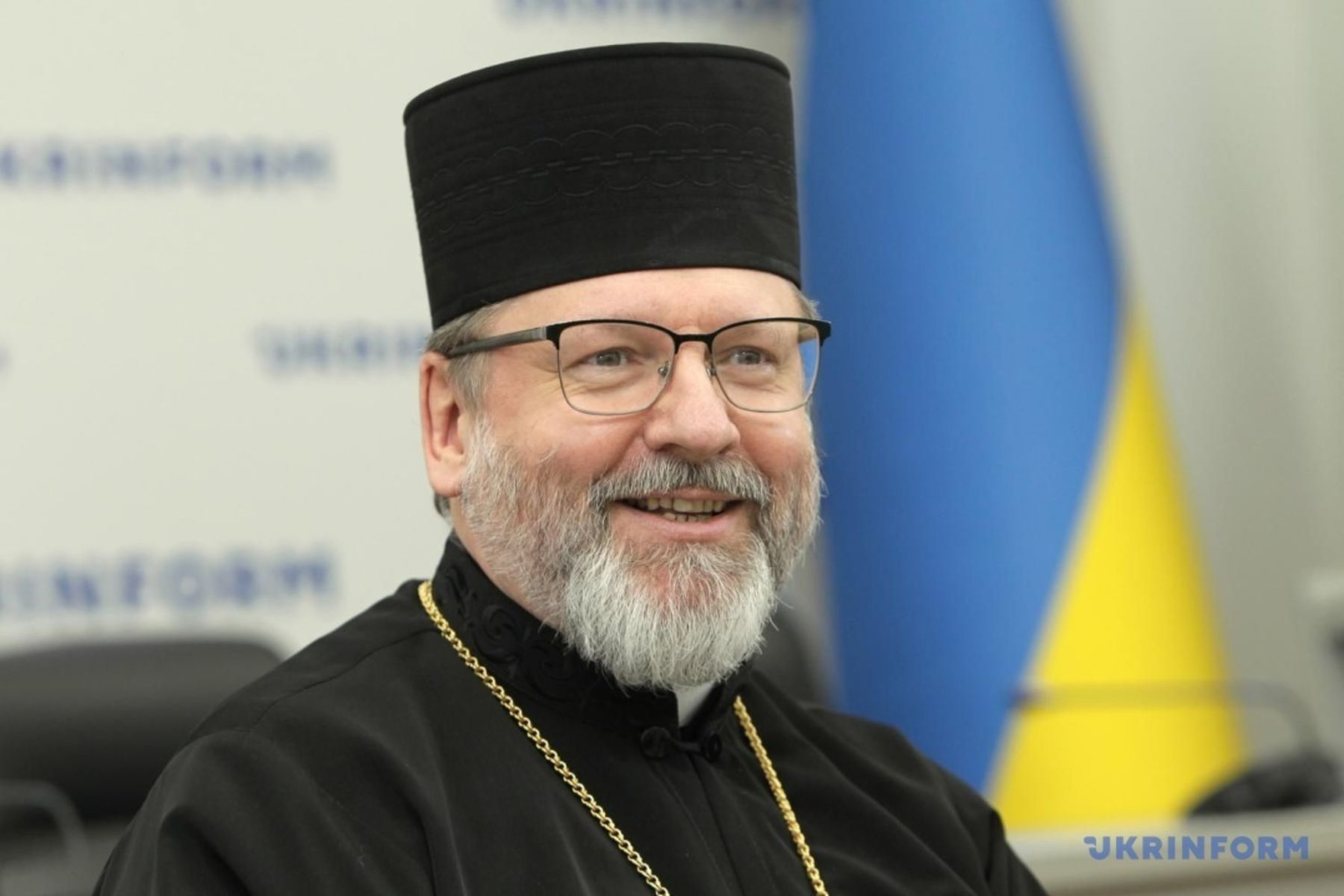
“Ukrainians are rediscovering meaning and God — miraculously translating into resilience,” His Beatitude Sviatoslav
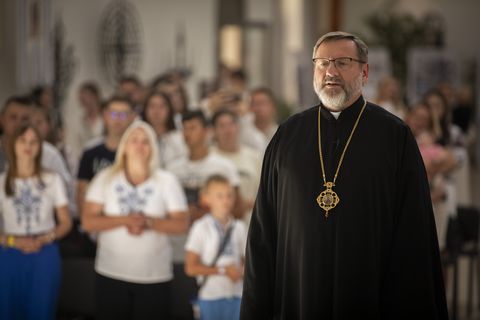
He makes an entrance into the Ukrinform press center and immediately becomes the center of attention. He speaks simply, often with a knowing smile, about complex issues and seems to spark a new dimension of thinking in everyone present. Listening to him is a pleasure.
The meeting between the Head of the Ukrainian Greek Catholic Church, His Beatitude Sviatoslav, and the Ukrinform team began with his words on the importance of journalists’ work, which he describes as “service to the truth.” “To serve the truth, it takes courage,” says His Beatitude Sviatoslav.
Continuing this theme of service in the context of war, he points out that ideological falsifications, propaganda, and manipulation began to “bombard” Ukraine long before the first Russian missiles and drones, and that journalists therefore became the first “information air defense.” “Every great war begins with a great lie,” the Head of the Ukrainian Greek Catholic Church aptly states. In his view, effectively countering this aggression requires being professional and intellectually superior to those waging information warfare.
The conversation then unfolds in the form of questions addressed to His Beatitude, ranging from political to existential: how a person’s faith changes when they experience trauma; the role the Church plays in this process; where the line lies between freedom of speech and accountability for words spoken in wartime; how the Vatican views Ukraine today; and more — in the full text of the conversation with the head of the UGCC.
A person who calls themselves spiritual has a duty to be the first to find the lost God, and then show others where He is
— Your Beatitude, how do you think the war has changed people’s spiritual life and faith? Very often, it is precisely in moments of unspeakable turmoil that people turn to God. What have you observed during this time — how have religiosity, spirituality, and service changed?
— You know, this is what has always happened throughout human history, and all the books of Holy Scripture testify to this: people come to know God through themselves and their own experiences — through tragedy and loss, as well as through discovery. People begin to understand God once they realize the need for their own salvation, to put it in spiritual terms.
In this regard, the dynamism of the human spirit in wartime has revealed eloquent and complex experiences. I am a medical professional by secular education, so perhaps I sometimes think and speak in medical terms. Today, we are essentially keeping our finger on the heartbeat of our people — a people who are in great pain. The pain and depth of the trauma caused by the war are not diminishing; they are only aggravating.
A traumatized person builds relationships in a special way — with God, with other people, and even with themselves. In religious experience, this became especially acute with the start of the full-scale war. Many people felt that the world we lived in had suddenly collapsed. It was as if God Himself had disappeared. And this gives rise to a very painful question: “Where are You? What happened?”
But eventually, another stage followed — the stage of finding the One who seemed to have disappeared. And here, the clergy play a special role. A person who takes on the responsibility of calling themselves spiritual has a duty to be the first to find this lost God and then show others where He is.
Today, we live in a vital period — a period of rediscovering purpose. People seek answers to profound, existential questions that no one can answer in human terms — neither the authorities, nor experts, nor any institutions. Only the Creator of this reality has the answers. We Christians say it is the Lord God.
And this search for meaning is miraculously transformed into a phenomenon of resilience. I do not know exactly how this works. I can only bear witness to this process. And perhaps this is the true experience of faith.
Let me share a story. I often visit hospitals where our wounded soldiers are undergoing treatment. Perhaps this is related to my past: I grew up in hospitals as a young man. Once, I approached a young man. He had lost both legs and one arm, and his wounds were fresh and still open. He looked at me and said, “Bless me, Father.”
I approached him and, frankly speaking, wondered what he would ask for. As if reading my mind, he added, “It doesn’t hurt so much that I lost my legs and arm. What hurts most is that I don’t know why.” I will never forget those words.
And then, quite spontaneously, in a Christian way, I felt that the wounds this young man bore were the wounds of Christ, in whom I believe. I said aloud, “Jesus, is that You?” And I addressed him this way: “We believe in the suffering God — the God who took human pain upon Himself. He is in you. He is not far from you.”
In an instant, this young man’s face changed. He looked at me and asked, “So He hasn’t forgotten me? He hasn’t abandoned me?” Finding meaning changed his attitude — toward himself, toward his situation, toward life. I tried to follow his fate later, and it truly is a success story.
In this horrendous war, we often cannot change the circumstances themselves. But we can change our attitude toward them. This is precisely what the difficult yet extremely important process of finding meaning is about today.
I would say that we are currently experiencing a moment of true conversion — in ecclesiastical terms. A moment of finding God and drawing closer to Him. This is a unique time. And my greatest concern is that our Churches are up to this challenge — that we are able to respond adequately to this search for meaning and clearly show people where to find the One they are seeking so desperately and wholeheartedly today.
— Please tell us how to frame the question correctly: why did God allow this situation to happen, or what was its purpose?
— I think both questions are legitimate. When we ask “why?”, we are actually trying to discern the ultimate goal, because we believe that history is not merely a series of random events. History has its own logic — an internal, eternal logic.
I often recall my teacher, who said: if you don’t see the logic in something, it means that some other logic is at work there. And in the context of Scripture, this is precisely about finding that logic — the divine perspective on the events in which we live.
At the same time, the question “why?” is also completely justified. Here we are speaking about our own experience. Human beings are intelligent, and it is difficult for them to live in chaos. Therefore, we naturally seek answers to questions such as: how should I react to what is happening, how should I respond to certain challenges and specific circumstances in my life?
So both questions are justified and necessary. But it is worth remembering that we are all merely seekers of answers. No one has ready-made, universal answers to all of life’s questions.
It is exceptionally significant that Pope Leo XIV reinstated Ukraine’s Constitution into the discourse of the “peace plan” for Ukraine
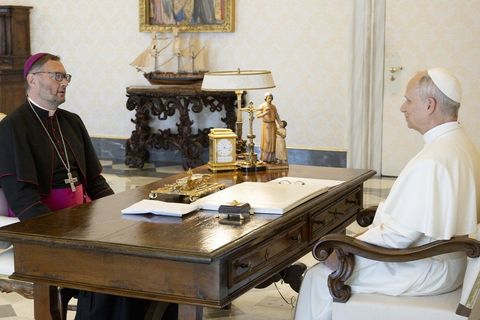
— You have met with the Pope on several occasions. What does he say about Ukraine? What is his stance? Because the statements we hear from the Holy See do not always seem as pro-Ukrainian as we would like them to be.
At the level of the Holy See, Ukraine is recognized as an integral part of the European context
— Are you referring to the previous Pope or the current one? When I became Head of the Church, Benedict XVI still held the office of Pope. Then there was the period of Francis, and now we are living in the period of Pope Leo. I will probably start with the present and then look back in retrospect.
Today we have a new and relatively young Pope. By the way, in terms of years of episcopal service, he is even younger than I am — which, I must admit, came as quite a surprise to me. For most of his life, he was the head of the Augustinian monastic order and only later became a bishop. It is also important that he spent the first years of his episcopal ministry in Latin America, in Peru. At that time, I was serving in Argentina, practically next door.
Today we have a Pope who views Ukraine through the lens of the European context. His vision — and therefore the current international position of the Holy See — is distinctly European. I will cite a few specific examples.
After Pope Leo XIV’s most recent meeting with the President of Ukraine, he made several statements to journalists. This took place against the backdrop of renewed external pressure on Ukraine, fresh attempts to find a “peace plan,” and efforts to impose certain scenarios. The Pope then stated very clearly: “This is a war in Europe, and Europe must be a party to the negotiations. We cannot negotiate about Ukraine at the level of, say, the US and Russia.” We have not heard such a clear position for a long time. So, thank God, today even at the level of the Holy See, Ukraine is recognized as an integral part of the European context.
And this means one more important thing: an increasingly clear understanding that without Ukraine, there is no secure future for Europe. It is here that the fate of European security is being decided.
The second point is extremely illustrative. For the first time since the beginning of the war in 2014, the Pope publicly used the phrase “Constitution of Ukraine.” To be honest, I had never heard this term used in international discourse before — for some reason, it had fallen out of use. And the Pope emphasized that today it is impossible to seek any “peace plan” for Ukraine without respecting the Constitution of Ukraine.
With this single word, he reminded everyone that our Constitution enshrines the sovereignty and territorial integrity of the state, as well as its strategic development vector. Changing the Constitution of Ukraine to accommodate certain external factors is, thank God, not so easy. I am not sure that even parliament has a constitutional majority capable of taking such steps. It was a very professional and carefully worded statement — simply mentioning the Constitution, yet saying so much.
And the third point I would like to note is that this Pope is a man who approaches matters from an institutional perspective. He does not form his position based on personal emotions, haphazard impressions, superficial judgments, or an article he happened to read the day before. His conclusions are based on the work of an entire community — an analytical, intellectual circle that studies the situation in depth.
It is very important and gratifying for us that we are part of this circle. We are asked questions — genuine questions. We have the opportunity to convey the truth, and we see that this truth is taken into consideration. This reassures us that our testimony does not go unnoticed.
So these are the three key points. An entire lecture could be devoted to this, but I believe these are the most notable features and concrete messages that Pope Leo XIV has already made public. All of them are available in open sources.
There is a widespread belief that if the Pope were to visit Ukraine, the war would end
— The Church must stand alongside those who suffer most. Does it seem plausible that the Pope might plan a trip to Ukraine in the near future, at a time when we are facing an extremely difficult situation — war and a harsh winter?
— I don’t yet have any information about that. I know that certain sources have reported that something is being planned, but there is nothing official at this point.
At the same time, it is clear that awareness of the necessity of such a visit is growing. That is a fact. Because everyone who comes to Rome from Ukraine says the same thing: the Pope should come. What is important is that people from very different backgrounds — who have definitely not coordinated with one another — are saying this.
On our part, we try to reason by relying on the logic of precedents, because this is how the Holy See’s diplomacy often works today. Personally, I recall the precedent of Pope John Paul II’s visit to Sarajevo during the war in the former Yugoslavia. It was an incredibly courageous step. From a security standpoint, it was almost senseless. But John Paul II, who knew what communism was and deeply understood the logic of those who incite war and seek bloodshed, made this bold, prophetic gesture.
Therefore, speaking in terms of precedents, Ukraine today is, without exaggeration, more capable of ensuring the Pope’s safety than Bosnia was at that time. That is the first point.
The second point is considerably deeper. Today, at the level of ordinary people — what is called in theology sensus fidelium, the sense of faith of God’s people — there is a belief that if the Pope comes, the war will end. Why is that? Is it some kind of naïve automatism? No. It is an inner intuition of faith that should not be underestimated. That is why we constantly speak about it and encourage people.
However, I have to be honest: at the moment, I cannot say that the visit is definitely planned. Sometimes the Holy See announces the calendar of papal trips at the beginning of the year, but we have not heard of a visit to Ukraine being announced for the new year.
In fact, when we recall the visit of Pope John Paul II, it is worth noting one more thing: this year marks the 25th anniversary of his visit to Ukraine. This will be a very good opportunity to recall the messages he brought to us at that time. They sound remarkably relevant today.
At the same time, it is important to remember that that visit was prepared for almost a year. The Pope’s visit was officially announced a year in advance. And everyone — the Church, the state authorities, and the religious community of Ukraine — had enough time to prepare for it at the appropriate level.
We understand that Ukrainian society had very high expectations at the time. Every subsequent papal visit will be compared to that one. And we sincerely want the new visit to be no less impressive — in terms of its level, quality, and depth of preparation.
St. Augustine said that truth is like a lion; it does not need to be defended—it needs to be unleashed
— Where, in your opinion, does the line between freedom of speech and responsibility for what is said fall? Can we, in a state of martial law, equate the work of a journalist to that of a doctor to a certain extent — with the principle of “do no harm”? In other words, is it correct to think that if information could harm state interests, we can wait with it? How can we be responsible for our words without violating freedom of speech — something we are particularly proud of today and which we have to contrast with our enemy?
In wartime, words can kill — and words can save
— Very often, the power of a journalist’s words may indeed be compared to potent medicine. And the use of medicine is an art. Because sometimes a doctor sees that it is not worth using the strongest medication at this particular moment. Why? Because after it, no other treatment would be effective. In medicine, there is such a dose-response threshold, especially when it comes to hormonal drugs: after them, even antibiotics may no longer have an effect. Therefore, I believe that the responsibility for the spoken word is indeed on par with the use of a powerful drug.
But at the same time, we must understand another thing: sometimes silence can be even more dangerous. In theology, there is a very serious concept: to remain silent in the face of sin is to collude with it. This is an enormous responsibility.
I do not believe that there can be a truth that is truly harmful. It can hurt, yes. But the truth is always healing. I understand your question, and that is why I want to make a special request: treat your words with the utmost responsibility. In wartime, words can kill—and words can save. But silence can be even more destructive; over time, it turns into complicity in crime in a spiritual sense.
There is another vital spiritual aspect. Evil forces are always scared of light and gain strength when they are concealed. Today, we honor the memory of Macarius of Egypt, one of the Church Fathers, an Egyptian hermit. He asked a very simple yet profound question: why is it necessary to confess your sins to a spiritual father? And he answered: when you bring them to light, they immediately lose their power over you. But when you hide them, cover them with darkness, they grow and feed on that darkness.
Therefore, do not be afraid to bring the sins and flaws of Ukrainian society to light. This is vitally important. Because those seemingly omnipotent structures of evil, when exposed to light, lose their power. We are not afraid of the truth. Another thing is that people are often afraid to see their own flaws or to expose them — sometimes because it is convenient to live with them, and they do not want to change. It is always a spiritual struggle.
Obviously, I cannot offer you a universal recipe for all situations in life. Each time, you must make a personal decision, listen to your own conscience. But there is one image that I have frequently recalled lately. St. Augustine said: truth is like a lion. It does not need to be defended; it needs to be unleashed. It has its own power. There is no need to keep truth in a cage: open the door, and it will reveal its power all by itself.
For a long time, the Vatican did not believe that the Russian ambassador to the Holy See was capable of blatant manipulation or even deception
— Your Beatitude Sviatoslav, I cannot help but ask you about Russian propaganda and its influence on the Holy See: what messages do you personally and our Church have to fight against and refute?
It took the Vatican a long time to realize that it was on the front lines of the information war
— I must admit that I appreciate being called a diplomat. Perhaps this diplomatic dimension does come with experience, because the Church is, at its core, a network of relationships. And diplomacy is the art of cultivating relationships, especially international ones.
Today, most of our Church’s structures operate outside Ukraine. Therefore, every time I visit another country to meet with my faithful, such a visit inevitably takes on a diplomatic dimension. These are meetings with journalists — with your colleagues — as well as explanations, comments, and conversations. Our relations with the Holy See also unfold within this context.
Russian propaganda is indeed present there — dangerous, insidious, and extremely sophisticated. There is so much of it that at one point I even suggested to Pope Francis: “Your Holiness, we will prepare a pool of journalists who could help you articulate your message regarding Ukraine more clearly.” Unfortunately, this never happened. For a long time, the Vatican did not believe that propaganda could operate at the level of official diplomatic representatives. They did not believe that the Russian ambassador to the Holy See could engage in blatant manipulation or outright deception. Diplomacy is traditionally based on trust.
Let me give you one illustrative example. You probably know that two of our priests were kidnapped in Berdyansk. For almost a year and a half, we did not know whether they were alive, where they were being held, or what was happening to them. When, thanks to the efforts of the Ukrainian side and the diplomacy of the Holy See, their whereabouts were finally established, the Vatican requested official information about the conditions of their detention.
The Russian embassy reported where they were being held, the conditions they were living in, how many hours a day they were allowed to walk, what books they were reading, and so on. When I shared this information with the Ukrainian side and received verified evidence about the real treatment of prisoners in that colony, everyone was horrified. The gap between the official “picture” and reality was staggering.
This machine of deception and ideology constantly produces new “products.” Its information bullets are easy to recognize: short phrases or formulas that are fired everywhere and at everyone. We know very well what PSYOP is. But for a long time, the Vatican did not realize that it was on the front lines of an information war. Today, the situation is different.
We have built a mechanism of constant communication. Several times a year, our representatives meet with mid-level officials of the Roman Curia — not the top leadership, but those who shape the analytical environment. We systematically explain contexts, topics, and narratives to them. At the same time, we monitor where the next “information bombardment” is coming from.
Very often, it originates in the Italian media. They have their own specific features, but this is precisely the information space in which most Vatican officials live — they read Italian publications and respond to them. Therefore, we understand well how this propaganda works today, and in what forms it operates.
All Catholic bishops in the United States today stand with Ukraine
— There is a belief that Donald Trump can be influenced through religious organizations. Is this really the case?
— I think the idea that the religious community can directly influence Donald Trump’s decisions is largely exaggerated. We are dealing with a classic case of the instrumentalization of religious sentiment — and it should be called by its proper name.
Certainly, we use all possible channels to advocate for Ukraine, including religious ones, whenever the opportunity arises. But I will be frank with you: today in America, no one fully understands how decisions are made. No one. And if we do not understand the mechanisms of decision-making, it becomes even more difficult to speak about the real influence of religious figures on these processes.
In my view, it is far more effective today to speak to American society as a whole. The type of politics that currently dominates the world is populism in one form or another, and it is highly sensitive to public opinion. Influencing opinion leaders can therefore be effective.
At the same time, I want to be very clear: today, all Catholic bishops in the United States support Ukraine. There is not a single voice in the Catholic community that opposes us. This is despite the fact that, according to various estimates, about 52 percent of Catholics voted for Trump. Nevertheless, our dialogue with this community has been — I would say — successful.
Moreover, we are now increasingly being approached by the Protestant community. Last year, immediately after Trump’s inauguration, our Church and our bishops became the first religious delegation to be received by the new administration. I was invited to numerous meetings and interviews, including with Protestant media outlets — television and radio alike. One meeting in February last year was, without exaggeration, among the best I have had.
We are communicating, searching for paths forward, and I am confident that we will find them. But we must acknowledge that today everyone is in a state of deep shock. I remember well last February in Washington, when we were all trying to understand what was happening. In various institutions, I was told: “Your Beatitude, America today is like New York after the fall of the Twin Towers — everything is covered in a cloud of dust. We are stumbling through this cloud.”
Perhaps when the dust settles, it will become clearer what comes next. But for now, I see those clouds only rising higher and higher. And I am not sure that Americans themselves fully understand where they are heading.
Nothing in my life has been ever accidental—not a single encounter, not a single turning point—and now all of this is working for Ukraine
— You are known to speak several languages, particularly giving interviews in English. If possible, please share how many languages you know, how you learned them, and what helped you in this endeavor. This may be motivational for our readers.
— When it comes to language skills, I always say that language is, first and foremost, a means of communication — a way of relating to others. My experience is less the result of a deliberate strategy and more a personal life story.
My story begins in Argentina, in Latin America, where I immersed myself in Spanish. Later, already knowing Spanish, I began to study Italian. I remember how my predecessor, His Beatitude Myroslav Ivan Lubachivsky, when sending me to Rome for doctoral studies, said: “You already know Spanish — Italian will be easier. Go, maybe you will learn something.”
Indeed, I still have my notes from my first year in Rome: I listened to lectures in Italian and took notes in Spanish. In the middle, there is a mixture of languages, but by the end it is pure Italian. Today, Italian is the foreign language I use most often, because it is the language of Vatican diplomacy. Wherever you are, whatever country you find yourself in, the papal nuncio speaks Italian, and all official communication takes place in that language.
English, on the other hand, has become the universal language of international communication. It is difficult to imagine modern diplomacy without it. In many ways, it has replaced French. I remember my first foreign passport: my surname, Shevchuk, was transliterated according to French rules — you can imagine how many extra letters that involved. Even my Vatican diplomas carried that transliteration, because I arrived to study with that passport.
I began learning English back in Soviet school, but, as you probably know, very few people there learned it for real communication. The real breakthrough came after I defended my PhD, when I received a scholarship to study English in San Francisco. I lived in a Dominican monastery for several months and studied with private tutors, which allowed me to truly immerse myself in the language. California, too, is a special part of America, with a very distinctive cultural atmosphere.
Then there was Rome, and later Greece. His Beatitude Lubomyr sent me to Athens to establish the first Ukrainian parish there, and I left everything behind to study modern Greek. It was a unique experience.
My doctoral research focused on a theologian who wrote in French, so I had to learn French — not for conversation, but for reading primary sources in the original. In academic theology, if you rely only on translations, you simply will not be taken seriously as a scholar.
Over time, I have accumulated quite a few languages. But I do not see this as any special achievement. Each of us is shaped by our own life story. Only now do I understand that nothing in my life was accidental — not a single encounter, not a single turning point. Today, all of it serves Ukraine, and our shared truth.
At one point, I even had an inner struggle with God and asked, “Why did you bring me to Argentina?” In the 1990s, we were isolated from information there: radio signals from Ukraine did not reach us, and letters took two months to arrive. Only now am I beginning to understand why.
Pope Francis, when he was still Archbishop of Buenos Aires, was my immediate superior. When difficulties arose — and there were many, because for a time I was the youngest bishop in the Catholic Church — I turned to him. I remember his words well: “Forget the idea that a bishop is a prince sitting on a throne. A bishop is someone who kneels and washes feet.” These were fundamental lessons in pastoral ministry.
I could never have imagined that our next meeting would take place in the Vatican, after he became Pope. It was beyond anything I could have foreseen.
Virtual space, too, needs to be filled with spiritual content, and artificial intelligence should not be demonized
— How does the Church view artificial intelligence — as a threat or as a blessing?
From a moral standpoint, most of what humans create is neutral—it can be used for good or for evil
— I use artificial intelligence myself — I have the ChatGPT app on my phone. And when Pope Leo XIV explained why he chose this name, one of his arguments concerned the newest challenges associated with artificial intelligence.
We are dealing with an objective phenomenon that is constantly changing and evolving. We do not yet fully understand what we are facing, but we cannot escape it. From a moral standpoint, most things humans create are neutral — they can be used for good or for evil. Our challenge is to learn how to use these technologies for good.
I remember the discussions about virtual space during the pandemic: whether online prayer is “real” or not. But the fact is that we already live a significant part of our lives in the virtual dimension. At the same time, offline communication remains irreplaceable. We need personal encounters, eye contact, and the sound of a living voice.
One of the papal synods addressed the evangelization of cyberspace and described it as a “new continent.” But one journalist aptly noted that it is not a continent, but a dimension of our lives — a space in which we spend a huge part of our time. And it is precisely this space that needs to be filled with spiritual content.
New technologies pose delicate and complex questions. I once participated in a Vatican conference on the cyberization of the human body. On the one hand, such technologies help the wounded and provide prostheses for soldiers. On the other hand, medicine is increasingly replacing rather than healing: artificial teeth, knees, implants. Is this the right path? The question remains open.
Technology even changes how a person perceives their own body. I heard a story about a child who, accustomed to gadgets, tried to “turn” the page of a magazine with his finger — and when it did not work, he looked at his finger as if something were wrong with it. This is a profound challenge to our worldview, our culture, and the Christian understanding of reality.
We live in interesting times. Religiosity, too, will change in its forms of experience and expression. Our task is not to be afraid, not to demonize new phenomena, but to accept them as part of the reality in which we are called to carry out our ministry.
Today, Ukraine stands at the epicenter of tectonic spiritual, cultural, and ideological shifts
— Let’s return to your idea that in critical times people often “lose God,” and that the clergy should be among the first to find Him. In this context, does the Ukrainian clergy — especially military chaplains — experience a particular depth of meaning that helps people persevere? And more broadly, does the international community notice that Ukraine is giving birth to new meanings today: in military experience, journalism, literature, and spiritual reflection on war? Is Ukraine becoming one of those centers that shape contemporary meanings precisely because of the trials it has endured?
— It is evident that today we are at the epicenter of global transformations. And our experience — military, journalistic, ecclesiastical — is in many ways at the forefront of the modern world.
My colleagues in medicine often say that just a few years ago it was extremely difficult for a Ukrainian doctor to publish a scientific article in an international journal. Today, the situation has reversed: foreign specialists are coming to Ukraine to learn. This is because peaceful countries simply do not have experience in treating such complex combat injuries. I believe something similar is happening in the sphere of spiritual understanding.
When we speak about experience — especially the experience of war — I remember well the first months of the full-scale invasion. Here in Kyiv, we were practically under siege. And I suddenly realized that people from other regions of Ukraine — even from Galicia — who had lived through a different kind of war experience, simply did not understand me. Not at all. And then I thought: if it is so difficult for us to understand one another within the country, how difficult will it be to communicate with those abroad?
My understanding was shaped by the image of a stone thrown into water. There is an epicenter, and waves spread outward from it. Today, we are living at that epicenter. By the time the wave reaches the “shore,” ten new transformations will already have taken place here. This is where tectonic plates are shifting right now — spiritual, cultural, and worldview plates.
That is why it is so important for us to speak to the world. Our experience — spiritual, intellectual, and pastoral — will be needed not only by us. Military chaplains, priests, journalists, and writers are living through a reality today that will eventually become material for global reflection.
I am deeply convinced that, sooner or later, the war will end. It will end with our victory. But after that, we will face new challenges — new tensions and new divisions within society. Unfortunately, these divisions will follow the lines of different wartime experiences, because the burden of war has fallen unevenly on our people.
Some have lived through the reality of the front lines; some have experienced occupation; some were forced to live abroad; others remained in relatively peaceful regions. Everyone will carry a different depth of trauma, a different sense of justice, a different vision of Ukraine’s future — and even a different understanding of what victory means. For some, it may feel like defeat; for others, like triumph.
That is why the creation of meaning will become one of our central challenges — especially for those who communicate: clergy, intellectuals, journalists. It will be a special form of service to the people — helping us to understand one another.
When we appeal only to rational arguments, we often fail to hear each other. Today, people are searching for shared experience. And it is precisely shared experience — even when it differs in form, but is lived through honestly — that can become the foundation that helps us remain resilient and build a space for future unity.
Myroslav Liskovych
Ukrinform