“The Church in Ukraine and the Diaspora Finally Reunited”: The 35th Anniversary of Cardinal Lubachivsky’s Return
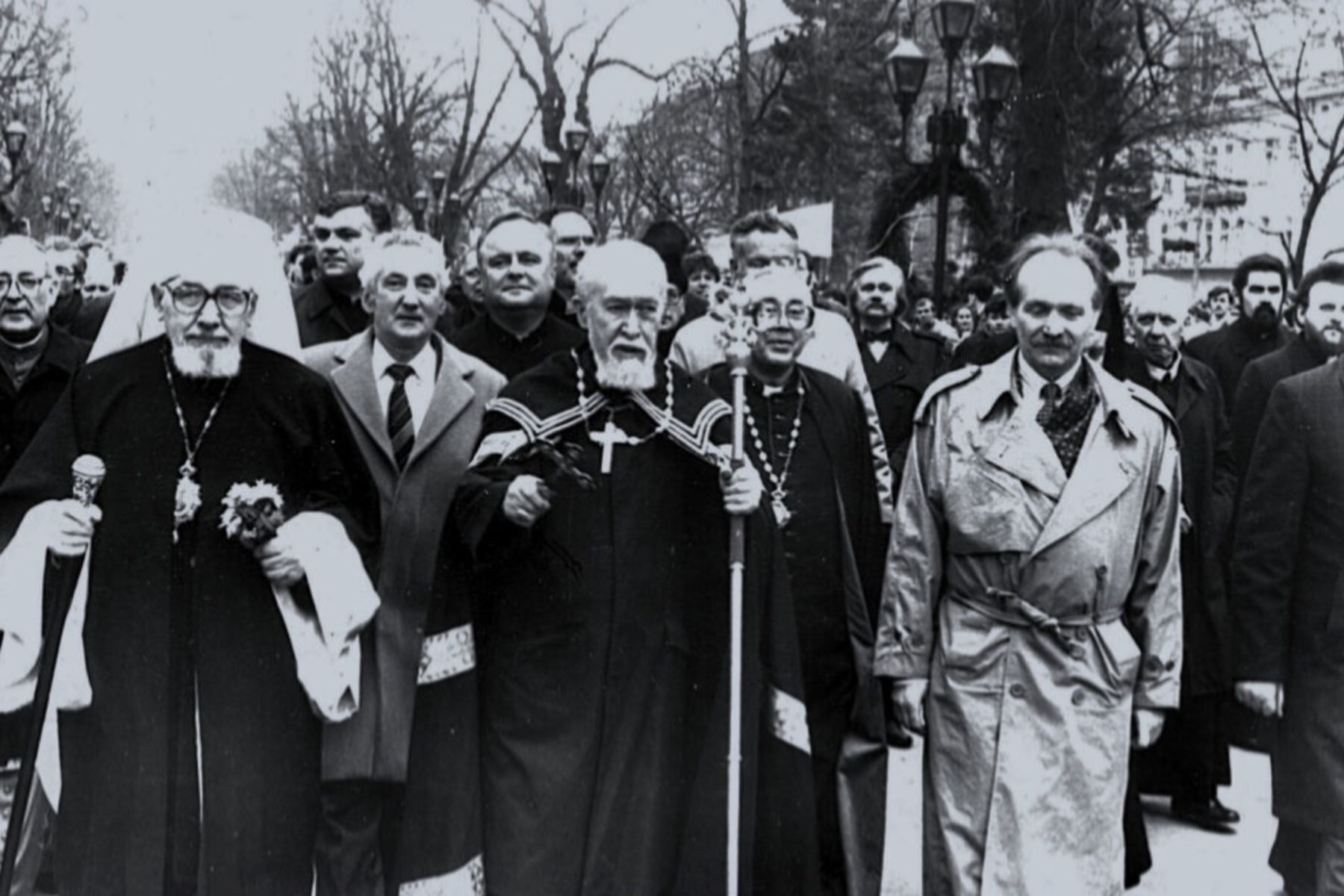
On March 30, 1991, Myroslav Ivan Cardinal Lubachivsky, Father and Head of the Ukrainian Greek Catholic Church, solemnly returned to his seat in Lviv after decades of forced exile. This return was not merely a matter of personal significance, but a symbol of the UGCC’s emergence from the underground and the restoration of its full life in Ukraine.
Following the death of Patriarch Josyf Slipyj in 1984, Myroslav-Ivan Lubachivsky became Head of the UGCC, and the very next year, Pope John Paul II appointed him to the College of Cardinals. He became the fourth cardinal in the history of the UGCC. At that time, he was outside Ukraine and for many years was unable to return to his homeland. Even in 1988, during the celebration of the 1,000th anniversary of the Baptism of Rus-Ukraine, he was unable to travel to Soviet Ukraine and instead participated in the celebrations in Częstochowa, Poland, together with Ukrainians living in Poland.
Only when the Soviet system began to decline and the UGCC emerged from the underground did it become possible for its Head to return to Lviv. This occurred on March 30, 1991—an event that brought to an end the prolonged period of the UGCC’s underground existence and signaled the Church’s return home.
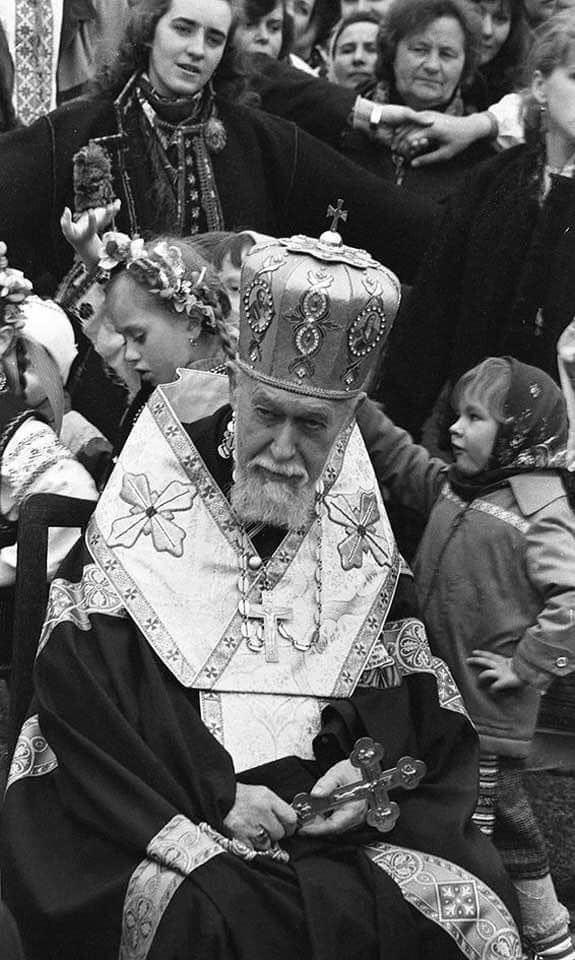
Interestingly, the patriarch himself was awaiting this meeting with great trepidation and even fear.
“I don’t know how I’ll perform there, — admitted Myroslav-Ivan Lubachivsky. — Because I don’t know these people — I haven’t been with them for 53 years. They think I’ll do something extraordinary, forgetting that I’m just an ordinary person—and an old one at that; I’m already 77 years old. And I wonder if I’ll be able to meet their expectations and fulfill their hopes for me. May God grant that I can. I’ll do my best to do everything I can.”
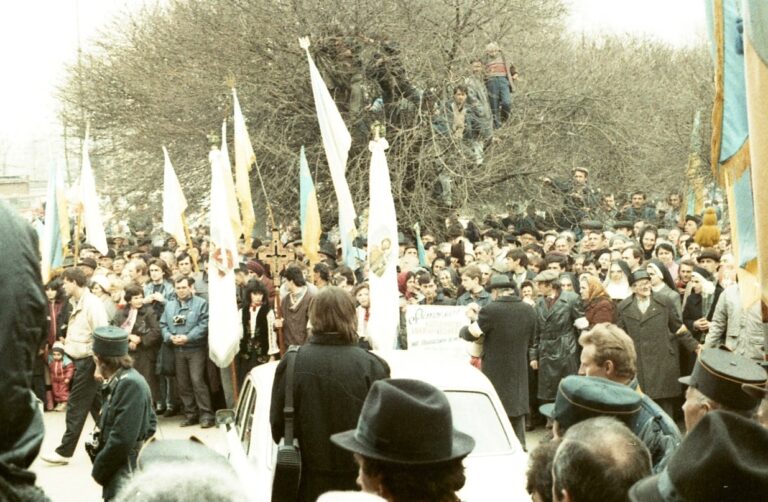
Yet, despite these concerns, the meeting in Lviv turned out to be remarkable. Eyewitnesses recall that people came out to greet him in whole families, gathering along the road, near St. George’s Cathedral, and on the city streets. Many compared that visit to Jesus’ entry into Jerusalem—so solemn and moving was this gathering. People cried, prayed, and welcomed their patriarch, who was returning home together with his Church.
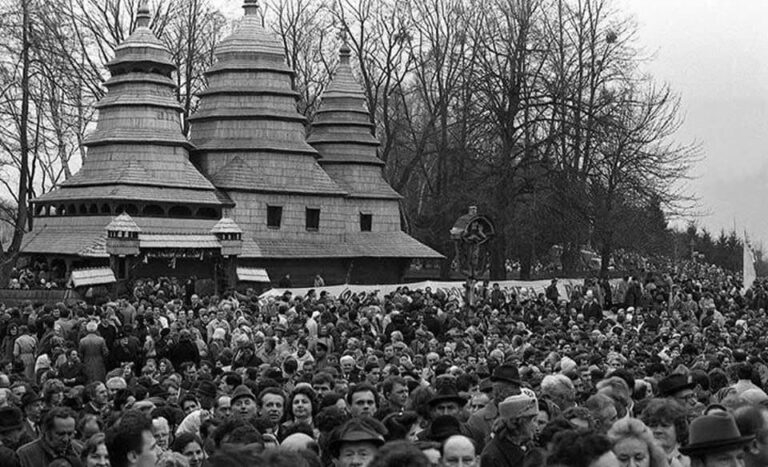
Patriarch Myroslav-Ivan Lubachivsky’s reception by the people of Lviv
Metropolitan Borys Gudziak of Philadelphia, who accompanied the cardinal on his return journey, recalls: “It is difficult to forget or overstate the importance of this historic moment. Cardinal Lubachivsky was returning home to ‘his own people’, and the Church in Ukraine and in the diaspora was finally united.”
The first thing he did after returning from exile was to go to his family home in Dolyna. And later, he began the enormous task of reviving the Church in Ukraine: he established the archiepiscopal curia, created new eparchies, reorganized the clergy’s structures, ordained new priests, established relations with the Orthodox, and devoted considerable attention to education and youth.
In 1992, he convened the first Synod of Bishops of the UGCC in Ukraine; in 1994, the Lviv Theological Academy (now the Ukrainian Catholic University) resumed its activities, and the Drohobych Eparchial Catechetical Institute and the Drohobych Theological Seminary were established. During his ministry, new eparchies were created, hundreds of priests were ordained, and structures were developed without which it is difficult to imagine the life of the Church today.
The cardinal also paid great attention to charitable work—it was during this time that the Metropolitan Andrey Sheptytsky Hospital was reopened in Lviv, and branches of the international charitable organization “Caritas” began operating in Ukraine.
Cardinal Lubachivsky’s return to Lviv was not merely his homecoming. It was the Church’s return to its people, a return from exile, from the underground, from division. And so, for many people, that day truly felt like a triumphant and joyous homecoming—after long years of waiting, their patriarch was returning to his people.
This event—with its atmosphere of anticipation, the journey home, and the welcome in Lviv—is preserved in the documentary film “Greetings to You, Ukrainian People,” produced by the UGCC Press Service in collaboration with the BBC.
The UGCC Department for InformationFirst photo: The Patriarch’s Return to Lviv. Front row, from left to right: V. Sternyuk, M. — I. Lubachivsky, V. Chornovil, 1991. Photo credit: Volodymyr Sakvuk